We've tested 25+ AI image and video models. Here's what actually matters.
Lumen5 turns a script into an animated explainer video: one AI model draws every shot, and another brings each shot to life. Since 2024 we've put more than 25 of these models into production, measured them, and replaced most of them. Everything below comes from over 400,000 generations by real Lumen5 users in the past year, not cherry-picked demos.
Published October 30, 2026 · Based on Lumen5 customer generations from November 2025 to October 2026
Storyboard shots
Nano Banana 2
Google's image model draws every shot of your storyboard. Lumen5 users have generated more than 217,000 frames with it, and only 0.66% of requests fail.
Animation
Gemini Omni Flash
Turns each shot into a moving clip. The median clip is ready in 39 seconds, about 4x faster than the model it replaced.
Characters & props
Nano Banana 2 Lite
Draws the reusable characters and objects that keep your video consistent from shot to shot, in about half the time of Nano Banana 2.
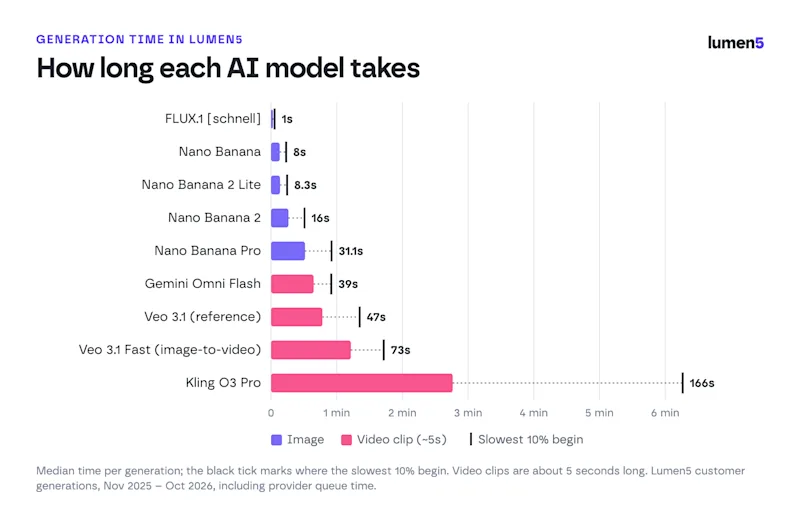
Model | Type | Median | Slowest 10% over | Failed | Sample |
|---|---|---|---|---|---|
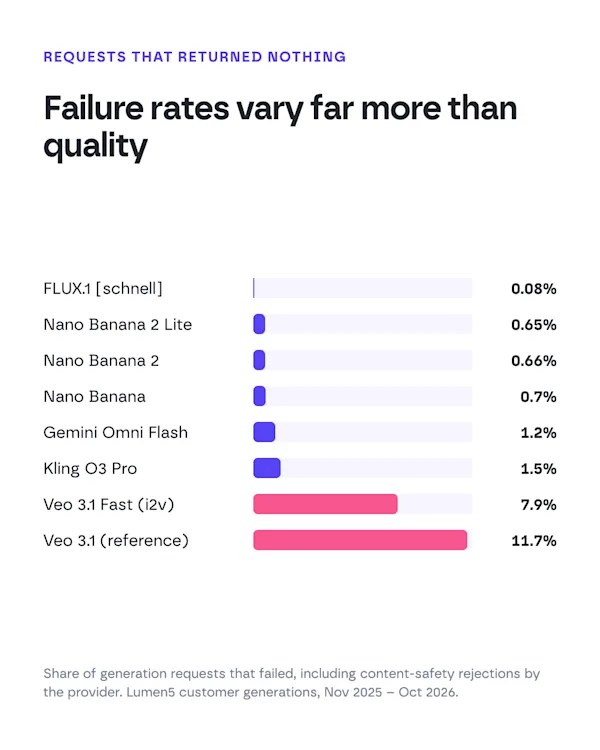
FLUX.1 [schnell] | Image | 1.0s | 3.3s | 0.08% | 102k |
Nano Banana | Image | 8.0s | 13.8s | 0.7% | 7.4k |
Nano Banana 2 Lite (edit) | Image | 8.3s | 14.7s | 0.65% | 36k |
Nano Banana 2 (edit) | Image | 16.0s | 30.6s | 0.66% | 218k |
Nano Banana Pro (edit) | Image | 31.1s | 55.3s | n/a | 1.5k |
Gemini Omni Flash | Video, ~5s | 39s | 55s | 1.2% | 17.7k |
Veo 3.1 (reference) | Video | 47s | 81s | 11.7% | 3.8k |
Veo 3.1 Fast (image-to-video) | Video | 73s | 103s | 7.9% | 3.7k |
Kling O3 Pro (reference) | Video, ~5s | 166s | 376s | 1.5% | 7.8k |
Failed requests include content-safety rejections by the model provider. Times run from request to finished file, including queueing.
Finding 1: A faster model beat a slightly prettier one
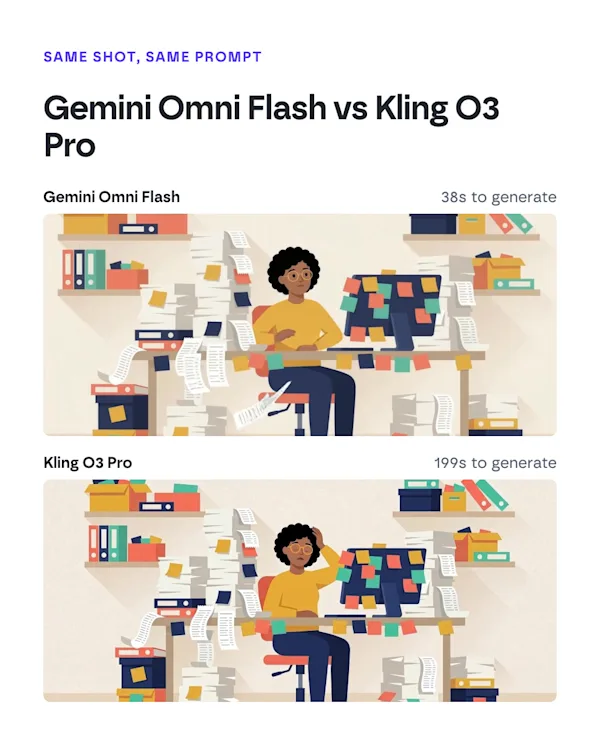
In July 2026 we ran our two best video models side by side on real explainer scenes: Kling O3 Pro on the left, Gemini Omni Flash on the right. Our own benchmark had shown a clear trade-off until then: slower models looked better. Omni Flash broke it. Our team rated it as good as or better than Kling on most scenes, and it was dramatically faster:
Median clip time: 39 seconds vs 166 seconds (about 4x faster)
Slowest 10% of clips: under 55 seconds vs over 6 minutes
Failure rate: 1.2% vs 1.5%
The surprise came after launch. Users didn't just wait less. They made about 60% more clips each and re-rolled shots they didn't love about twice as often, because trying again only cost 40 seconds. The share of people who finished and exported a video stayed the same (67% vs 63%), so the extra speed went into iteration rather than lost to abandonment.
As one of our team put it during the decision: "We would much rather users have slightly imperfect results much faster. The gaps are obvious to us because we're looking at two outputs side by side, but the average user only sees one."
Finding 2: Most people never change the default
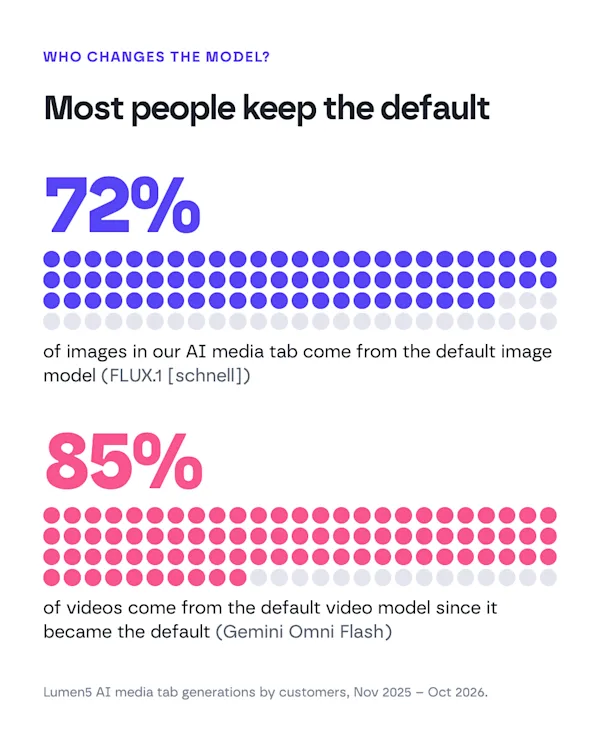
Lumen5 lets paid plans pick between several image and video models. Almost nobody does. The default image model accounts for 72% of all images ever generated in our AI media tab, and the default video model accounts for about 85% of videos since it became the default. Premium models that are one click away were each tried by only a handful of users.
That makes choosing the default the most important model decision we make, so we don't pick defaults from leaderboards. Each of our animation styles is tuned and tested against a specific image model and video model, and Lumen5 uses that pair automatically.
Finding 3: The image sets the scene, but the prompt tells the story
Reference beats first frame. Early on, our video model treated each shot's image as the literal first frame, so nothing could appear on screen that wasn't already there. Switching to reference-to-video models, which use the image as a style and content guide instead, made animations like icons popping in or objects entering possible.
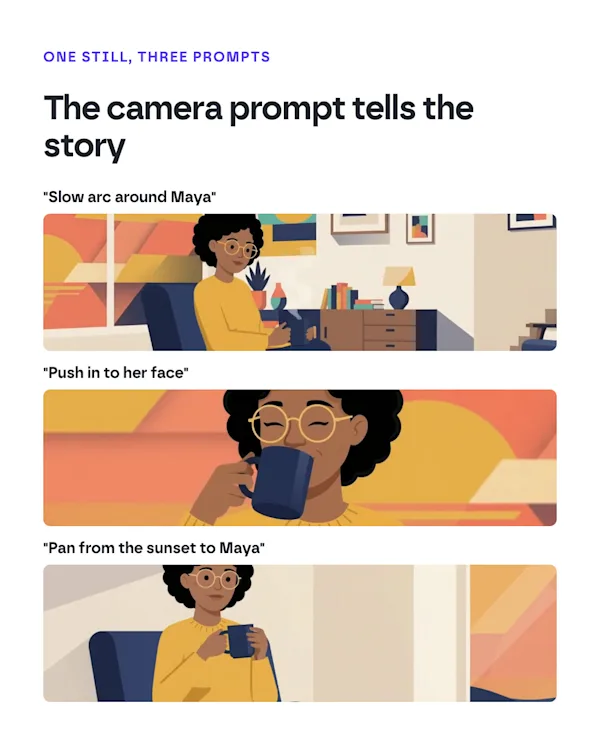
Camera direction matters more than the image. Our motion designers turned the same still into an arc shot, an over-the-shoulder shot and a pan just by changing the video prompt. Models also stretch camera moves to fill the whole clip, so "zoom in 30%" doesn't stop halfway.
Illustration beats photorealism for business video. Illustrated styles hide the small glitches that make photoreal AI video feel uncanny, and viewers don't mistake them for real footage.
Timing instructions finally work. Gemini Omni Flash was the first model we tested that reliably followed per-second timing ("the second icon appears at 2.5s"). Our motion designer called the timecodes "almost perfect."
Finding 4: Reliability varies more than quality
Top models look similar in a demo. In production they don't. In our data, failure rates ranged from under 0.1% for FLUX.1 [schnell] to almost 12% for Veo 3.1 reference-to-video. Every failure is a wait followed by nothing, which is why it counts as heavily as quality when we choose a model.
Many failures are safety filters, not bugs. Some models rejected harmless classroom illustrations because the prompt mentioned children. Rewriting prompts in age-neutral language ("a student" instead of "a young boy") fixed most of them without changing the picture. Lumen5 now does that automatically.
Finding 5: AI models don't last long
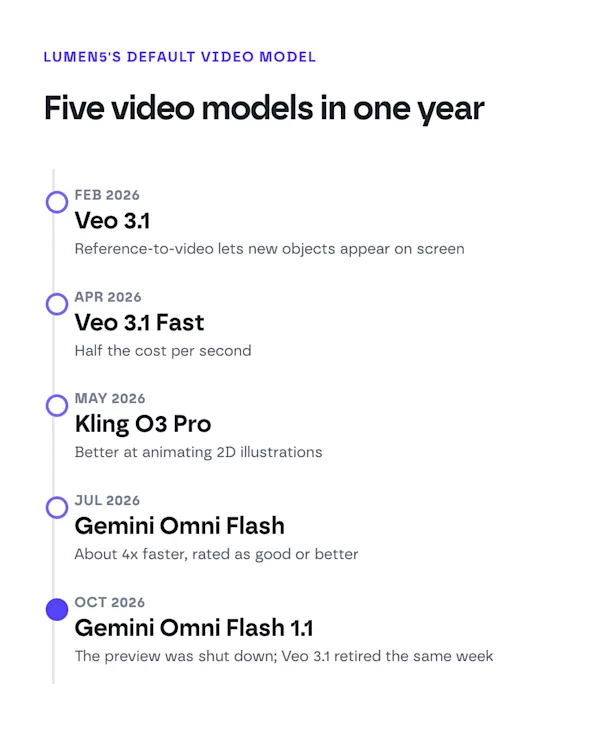
In the past year, Google retired the Imagen family and every Veo 3.1 model, OpenAI wound down the Sora 2 API, and the first Gemini Omni Flash preview was replaced less than six months after launch. Lumen5's default video model changed four times in 2026 alone: Veo 3.1 → Veo 3.1 Fast → Kling O3 Pro → Gemini Omni Flash → Gemini Omni Flash 1.1.
Each switch meant re-running our benchmarks and re-tuning every animation style for the new model. If you build videos in Lumen5, none of that is your problem: your styles keep working when the model underneath them changes.
Old AI image problems, retested
When we started, image models failed in predictable ways, so we wrote rules into every Lumen5 prompt to avoid them:
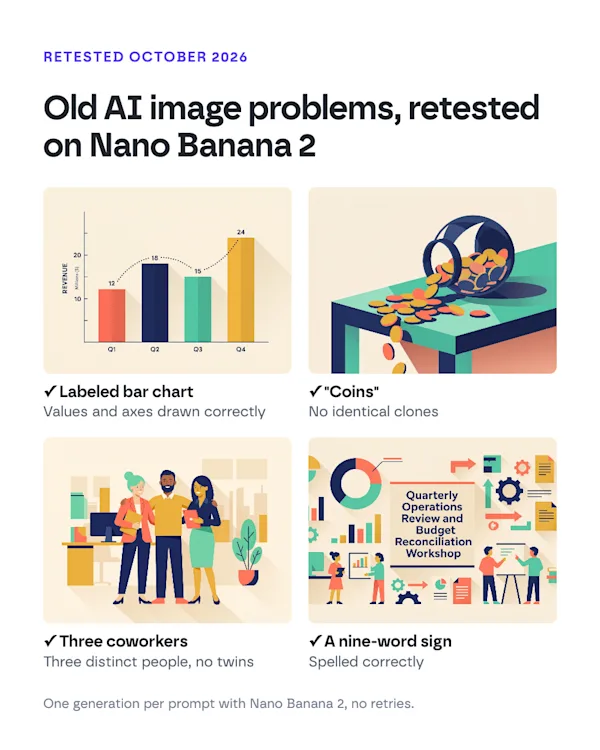
Charts and tables came out as jumbled bars and unreadable axes, sometimes with an invented extra line.
Long labels got misspelled, so we kept on-image text to four words or fewer.
People without distinct details came out as near-identical twins.
Plural objects ("coins") came out as identical clones.
In October 2026 we retested Nano Banana 2 on all four: a labeled bar chart, a jar of coins, three coworkers and a nine-word sign. It got every one right on the first try. Image models are improving faster than the folklore about them. We keep the rules anyway, because they cost nothing, and video models still struggle with charts.
Today Lumen5 uses Google's Nano Banana 2 to draw storyboard shots, Nano Banana 2 Lite for characters and props, and Google's Gemini Omni Flash to animate each shot. Free plans generate images with FLUX.1 [schnell]. We've tested and retired more than 25 other models along the way, including Veo 3.1, Kling, Sora 2, Imagen and Recraft.
Yes. In the AI media tab, paid plans can pick from several image and video models. Animated explainer styles use the model pair each style was tuned and tested with, so you get consistent results without having to choose.
With Gemini Omni Flash, the median five-second clip is ready in about 39 seconds, and 90% are ready within 55 seconds. Storyboard images take about 16 seconds each, and Lumen5 generates them in parallel.
We tested Seedance 2.0: its motion was lively, but it cost more than 50% more per second than Veo 3.1, so we haven't released it. Veo 3.1 and Sora 2 were retired by Google and OpenAI in 2026, and Lumen5 moved to Gemini Omni Flash.
We run every candidate through a benchmark of real explainer scenes, have our motion designers rate the results side by side, and soft-launch the winner before making it the default. We weigh speed and reliability as heavily as visual quality.
For business explainers we recommend illustrated styles. They hide the small inconsistencies AI video still has, read clearly at small sizes, and aren't mistaken for real footage.
Nano Banana 2
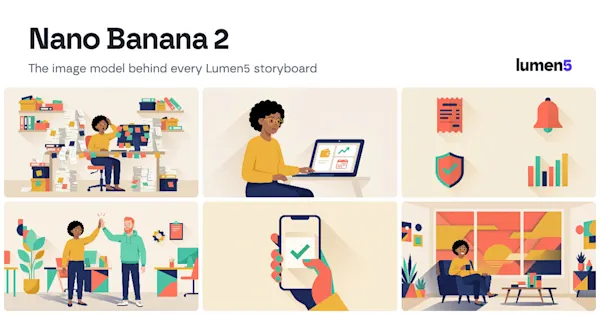
Nano Banana 2 draws every shot in Lumen5's animated explainers: more than 217,000 frames so far. Here's what it does well, where it struggles, how it compares with Nano Banana Pro and GPT Image 2, and how to use it to make videos.
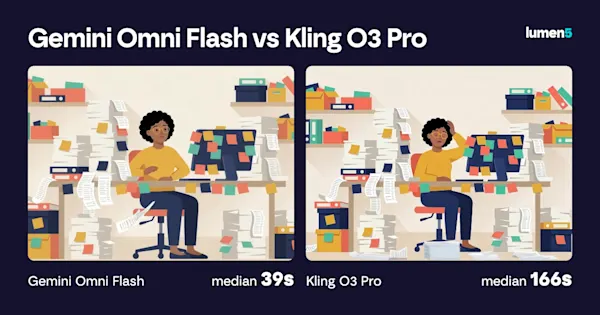
Gemini Omni Flash vs Kling O3
We compared Kling O3 Pro and Gemini Omni Flash across 25,000+ real animated explainer clips. Omni Flash was about 4x faster at the median, just as reliable, and rated as good or better on most scenes. Here's the full comparison.
AI Video Generator
Lumen5’s AI Video Generator transforms scripts, blogs, URLs, and ideas into polished videos in minutes. Upload your content, and our AI automatically builds scenes, selects visuals, applies motion, and matches your brand, giving you professional-quality videos without editing expertise.
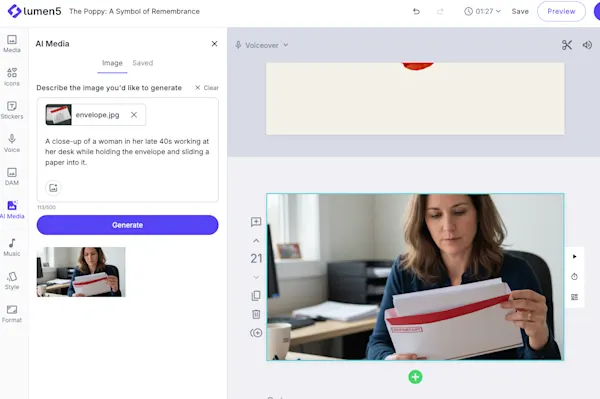
AI Image Generator
Lumen5’s AI Image Generator transforms text prompts, ideas, and concepts into polished, on brand images in seconds. Generate custom visuals that match your style, tone, and brand identity without relying on stock libraries or design teams.