Gemini Omni Flash vs Kling O3 Pro: which AI video model is better for explainer videos?
Kling O3 Pro and Google's Gemini Omni Flash were both Lumen5's default video model in 2026. Between them they've animated more than 25,000 shots for our users. Here's how they compare on speed, reliability and the details that matter in a finished explainer, and why we chose Omni Flash.
Published October 30, 2026 · Based on Lumen5 customer generations from May to October 2026
Kling O3 Pro | Gemini Omni Flash | |
|---|---|---|
Maker | Kling AI | |
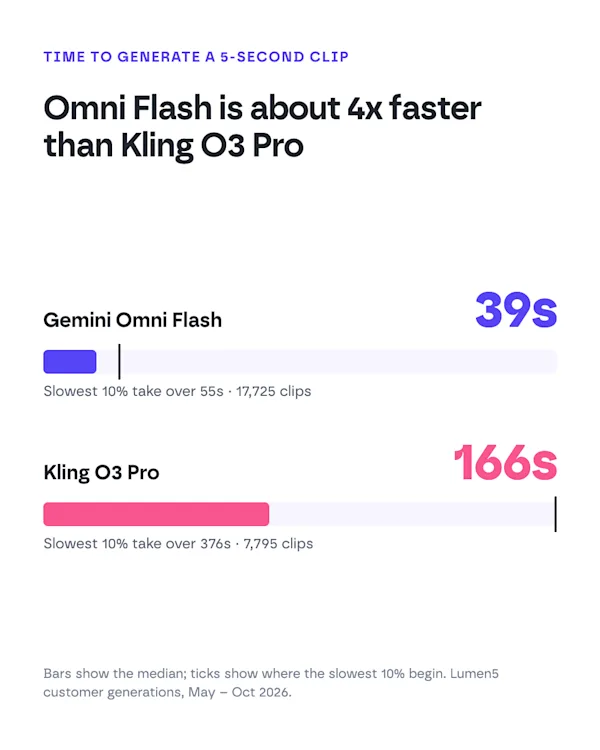
Median time per ~5s clip | 166s | 39s |
Slowest 10% take over | 376s | 55s |
Failed requests | 1.5% | 1.2% |
Clips measured | 7,795 | 17,725 |
Aspect ratios | 16:9, 9:16, 1:1 | 16:9, 9:16 |
Clip length | 3–15s | 3–10s |
Audio | Optional | Always generated |
Follows timing instructions | Loosely | Closely |
List price via fal.ai (720p) | ~$0.11/s | ~$0.10/s |
Speed and failure rates come from Lumen5 customer generations, May – October 2026, including provider queue time.
Kling O3 Pro overview
Kling O3 Pro is Kling AI's flagship reference-to-video model: give it reference images and a prompt, and it builds a clip around them. We moved to it from Google's Veo 3.1 in spring 2026, because it was noticeably better at animating 2D illustrations.
With Kling O3 Pro, you get:
Smooth motion and strong object interaction in illustrated styles
Expressive, animated-film-style faces
Square (1:1) output and flexible clip lengths from 3 to 15 seconds
Support for negative prompts ("no text, no extra people")
The trade-off is speed. In our data the median clip took almost three minutes, and the slowest 10% took more than six. Our team also found shots could feel static, and it occasionally invented details, like an extra person on a couch. Prompts are capped at 2,500 characters, which limits how much direction you can give it.
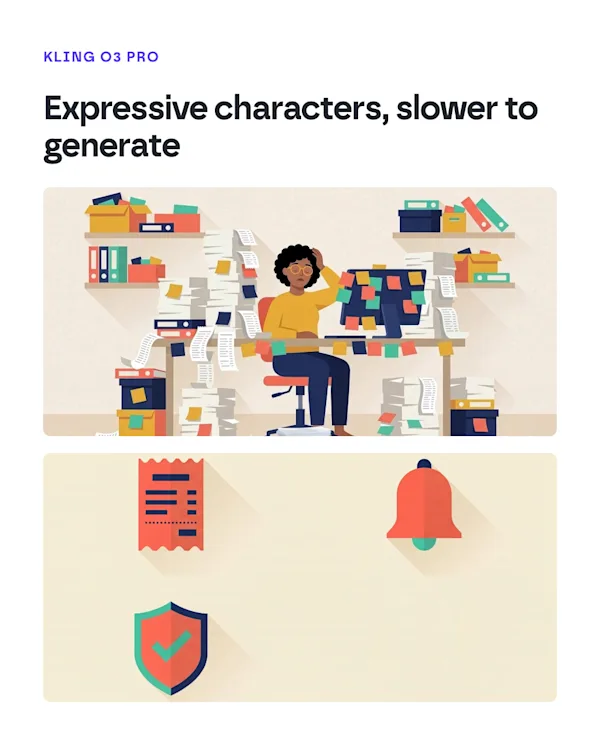
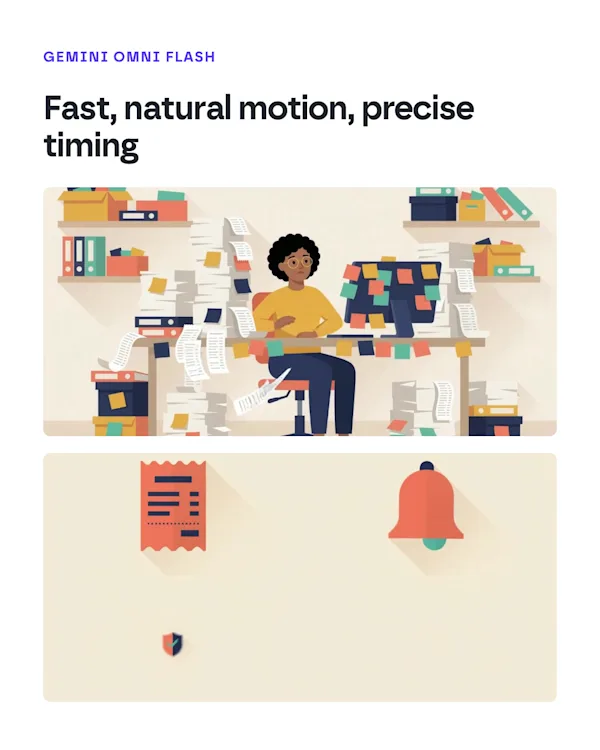
Gemini Omni Flash overview
Gemini Omni Flash is Google's fast video model. It handles text-to-video, reference-to-video and video-to-video. We soft-launched it as a "fast mode" alongside Kling in July 2026, and within two weeks it became Lumen5's only animation model.
With Gemini Omni Flash, you get:
Clips in well under a minute, even at the slow end
Unusually precise timing. Ask for an icon to appear at 2.5 seconds and it does.
Natural human and object motion
Room for detailed direction, with prompts up to 20,000 characters
Version 1.1 (October 2026) fixed an early bug where the reference image flashed on the first frame, and costs less
Its limits: it only outputs landscape (16:9) and vertical (9:16), it always generates audio, it sometimes adds more dramatic camera moves than you asked for, and it occasionally drifts away from the reference image.
How we tested
Benchmark. We built a benchmark of 20 real explainer scenes across our animation styles. Until Omni Flash, it showed a straight line: Veo 3.1 Fast was quickest and weakest, Kling O3 Standard was in the middle, and Kling O3 Pro was slowest and best.
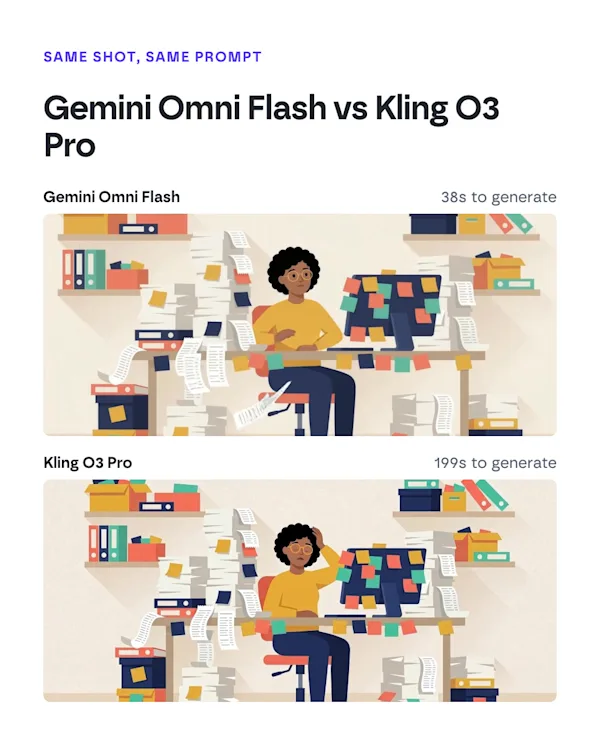
Side-by-side review. Our engineers and motion designers rated Kling and Omni Flash outputs on the same scenes, side by side. Omni Flash was as good or better on most of them and especially strong on icon-grid and timed scenes.
Production soft launch. We shipped Omni Flash as an opt-in fast mode, then made it the default once real-world results held up.
Real usage data. All speed and reliability numbers on this page come from Lumen5 customers' generations between May and October 2026, not lab runs.
Gemini Omni Flash vs Kling O3 Pro: key differences
Speed: Omni Flash is about 4x faster at the median and about 7x faster at the slow end. You can generate a clip three or four times in the time Kling takes to make one.
Iteration: After we switched, users made about 60% more clips each and re-rolled about twice as often, with no drop in how many finished their video.
Reliability: Roughly even. 1.2% of Omni Flash requests failed vs 1.5% for Kling.
Direction: Omni Flash follows timing and sequencing much more closely. Kling accepts negative prompts but caps prompt length at 2,500 characters.
Formats: Kling supports square video. Omni Flash doesn't, so Lumen5 animated explainers are landscape or vertical.
Style: Kling is excellent at expressive character animation. Omni Flash has more natural everyday motion but can over-direct the camera.
Which one should you choose?
Choose Gemini Omni Flash if you're making explainers, product videos or social clips where you'll iterate on several shots. Speed compounds: a 20-shot video is the difference between waiting about a minute per shot and waiting three to six.
Choose Kling O3 Pro if you need square output or a single hero shot with expressive characters, and you don't mind the wait.
Or skip the choice. In Lumen5, each animation style is already paired with the model it was tested on, and paid plans can still pick Kling in the AI media tab.
For explainer videos, in our testing, yes. It was rated as good or better on most scenes and is about 4x faster. Kling O3 Pro still has advantages for square video and expressive character animation.
Across 17,725 real Lumen5 generations, the median five-second clip took 39 seconds, and 90% finished within 55 seconds.
Across 7,795 real generations, the median was 166 seconds (almost three minutes), and the slowest 10% took more than six minutes.
No. Gemini Omni Flash outputs 16:9 and 9:16 only. Kling O3 Pro supports 1:1.
Yes. Paid plans can choose either in the AI media tab. Animated explainer styles use Gemini Omni Flash by default.
At 720p through fal.ai, Gemini Omni Flash 1.1 lists at about $0.10 per second and Kling O3 Pro at about $0.11. In Lumen5, both are included in your plan's animation minutes.