

The Moment Before the First Frame
Every marketer knows the moment before the first frame: the brief spark of an idea followed by a wall of UI. Before you can see anything moving on screen, you’re faced with templates, aspect ratios, voiceover choices, narrative styles. It’s a moment that should feel creative, but often feels like admin.
In mid-2025, our team started asking a simple, slightly uncomfortable question:
Why does making a video require so many decisions before you make a video?
That question became the seed for Chat to Video (known internally as Sketch).
Why We Built This
The Pain We Observed
Over dozens of dashboards, user feedback sessions, and internal discussions, a pattern kept surfacing:
New users weren’t failing because they lacked ideas. They were failing because the tool demanded fluency before showing them anything visual.
From our early internal planning notes (Aug–Sep 2025):
- “Too many clicks to create a video.”
- “Lots of early decisions users don’t fully understand.”
- “We want users to see a video right away from the tiniest bit of input.”
And the data? It painted the same picture we’d been sketching out ourselves.
Back in September, our Software Developer and MARS Team Lead, Antoine Morin-Paulhus, shared in. slack the following message:
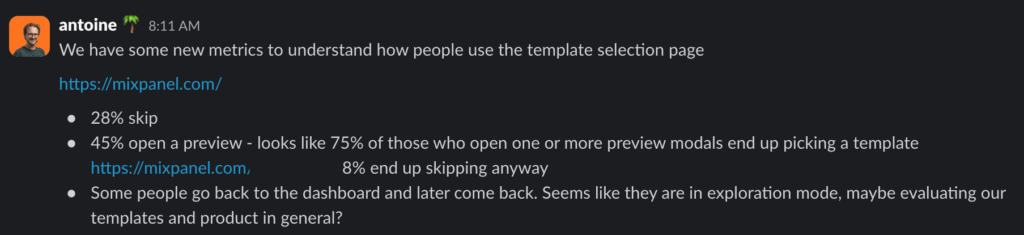
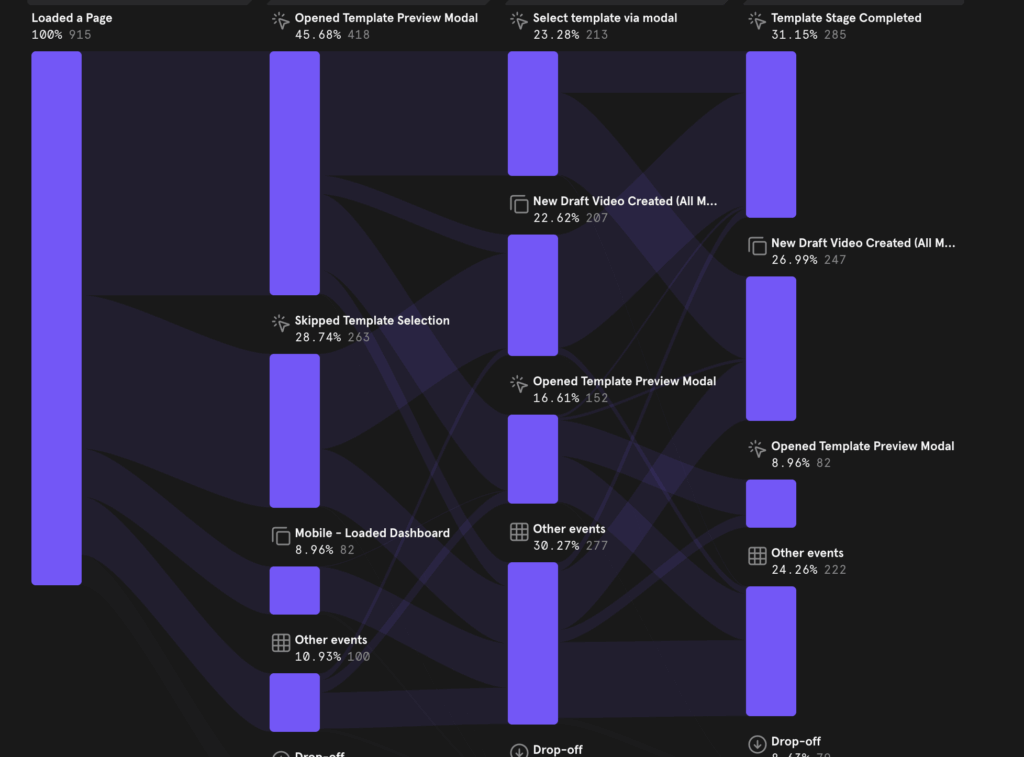
In the same thread, our Head of Product, Kaegan Donnelly added:
“Activation is quite a bit lower when users skip… I’d love if people could swap templates later. It’s hard to decide before you’ve even seen a video.”
This reinforced something we were already feeling strongly:
👉 Users don’t struggle with creativity. They struggle with getting past the tool’s front door.
Why Chat, and Why Now?
By summer 2025, chat-based interfaces had become the default way users expected to interact with AI — not just for writing, but for creating.
When asked why chat as an interface is important, our Head of AI & Co-Founder at Lumen5, Chris Bowal noted:
“Flexibility! We’ve had chat in Script Composer, but never for all kinds of videos. Users bring wildly creative inputs — chat lets Lumen5 match that creativity.”
Meanwhile, the team kept seeing user experiments that the editor wasn’t built to accommodate:
- People pasting in full scripts
- People uploading PDFs
- People wanting multiple video concepts from one idea
- People entering half-formed prompts just to “see what happens”
Chat was the perfect container for all of that.
A Shift Toward Creative Momentum
The turning point wasn’t a prototype or a design mock — it was a message.
On September 18, 2025, when Raj Muchhala (Senior ML Engineer) announced the beta rollout in Slack, the team got its first glimpse of what Chat to Video was about to become:

This announcement captured the core ambition of Chat to Video: remove every barrier between a marketer’s idea and their first visible draft.
No templates to choose upfront.
No formatting decisions required.
No creative paralysis at the starting line.
Just describe what you want, and see something come to life.
It was the moment the team shifted from thinking of Chat to Video as an experiment to realizing it could become the creative entry point for all of Lumen5.
How We Approached the Solution: A Chat-First Video Engine
A Radical Question
Somewhere between August ideation sessions and early September prototypes, the team landed on a radical premise:
What if your first video could appear the moment you described it?
No templates.
No aspect ratios.
No instructions.
Just… words.
This wasn’t a UI change — it was a philosophical shift.
From default video builder → to default video conversation.
The “One Output vs. Many Outputs” Debate
Every Lumen5 feature has its first internal firestorm, the debate that shapes its soul.
For Chat to Video, it was this:
Should Chat to Video generate multiple video drafts or just one?
Mackenzie Mitschke, our Senior Product Designer, summarized the early tradeoff:
“We’ve leaned toward one output, because multiple side-by-side options overwhelm users and slow them down, and weren’t obviously differentiated enough to give value.”
Multiple outputs would show variety…
…but also overwhelm.
One output would be faster…
…but maybe too restrictive.
After several messy discussions, we aligned around the single strongest principle: Start with momentum, not menus.
So Chat to Video would generate one focused result, and then open the door to rapid iteration via chat.
Chris affirmed this approach in November, when he shared:
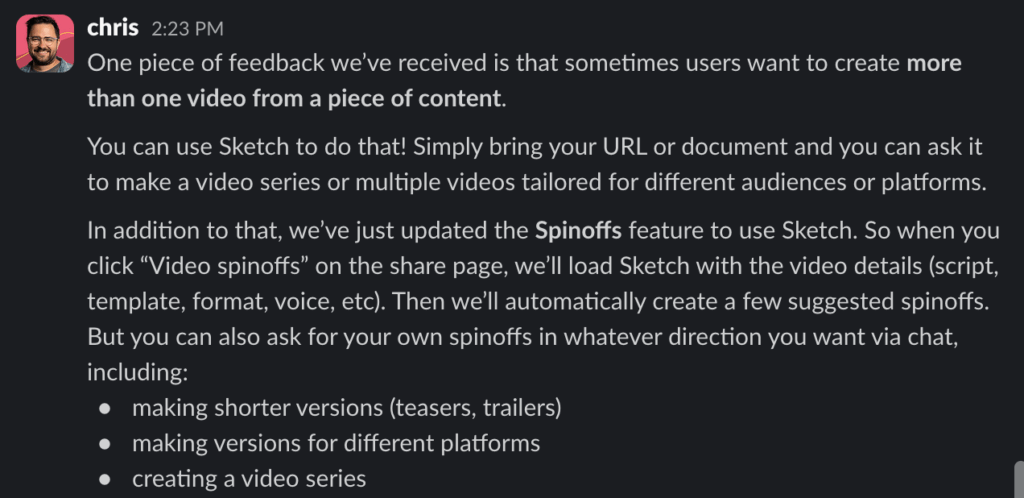
One output.
Infinite directions.
Prototyping the Experience — “Chat First, Video Second”
Prototype (Summer 2025)
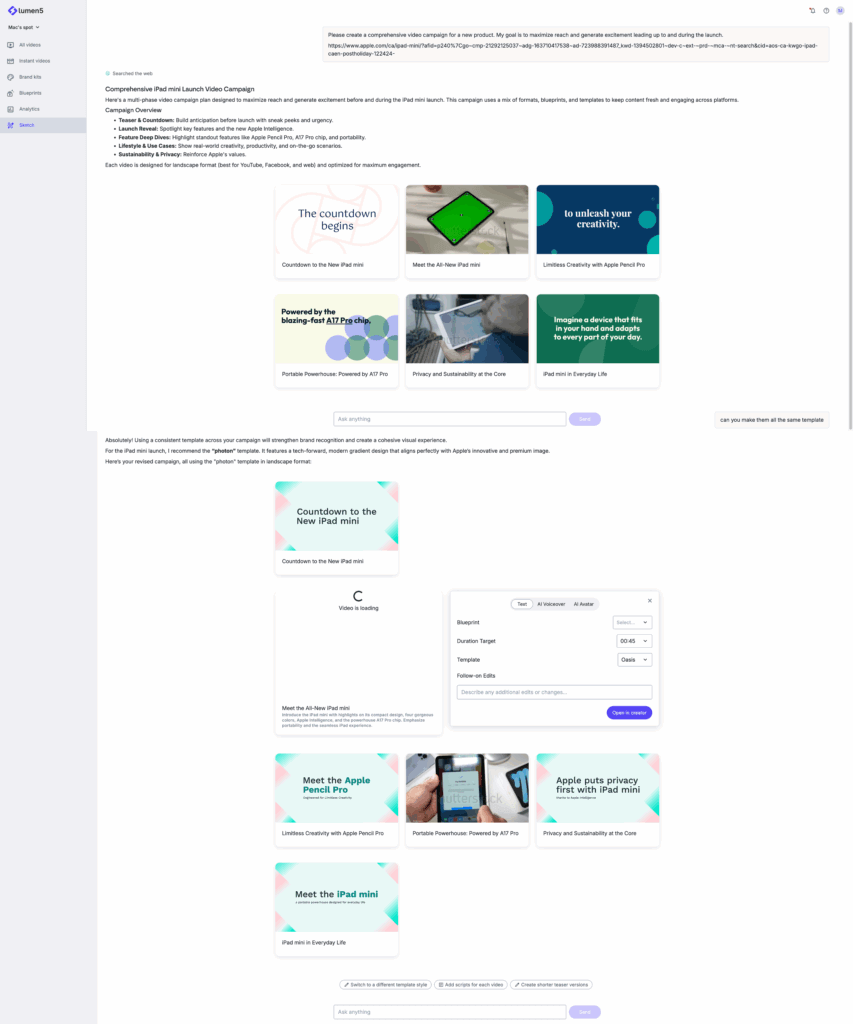
Mac, our product designer, described the earliest version with the following points:
- No strong visual focus on the video itself.
- Chat lived in a dominant single-column layout, and the video preview felt secondary.
- Video editing controls (like duration, aspect ratio, narrative choice) sat off to the side with no clear relationship to what the chat was doing.
- Overall effect: disjointed experience where the user couldn’t tell what the “main workspace” was.
This early layout revealed three problems:
- The video wasn’t the hero.
- Chat felt detached from the visual output.
- Editing controls had no clear relationship to chat actions.
It was functional — but not intuitive.
v1 — The Two-Pane Breakthrough
In late September, Chris dropped a message announcing the v1 breakthrough:
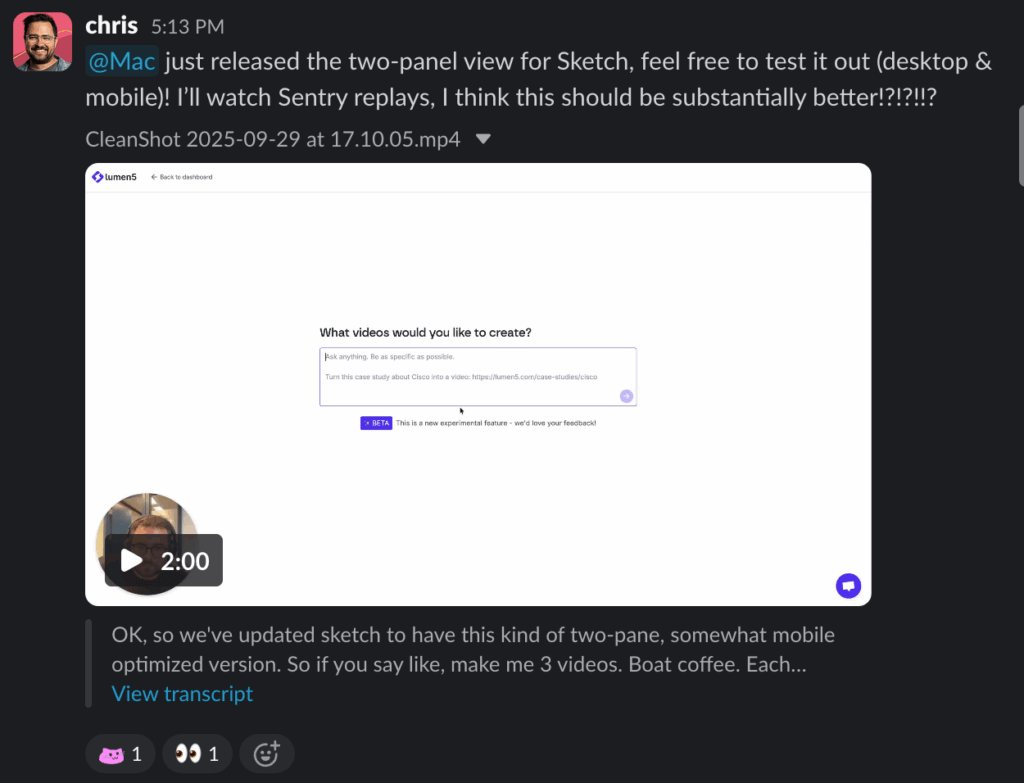
This changed everything:
- Video became the anchor.
- Chat became the creative input, not the whole UI.
- Controls aligned naturally with the preview.
And performance validated the direction.
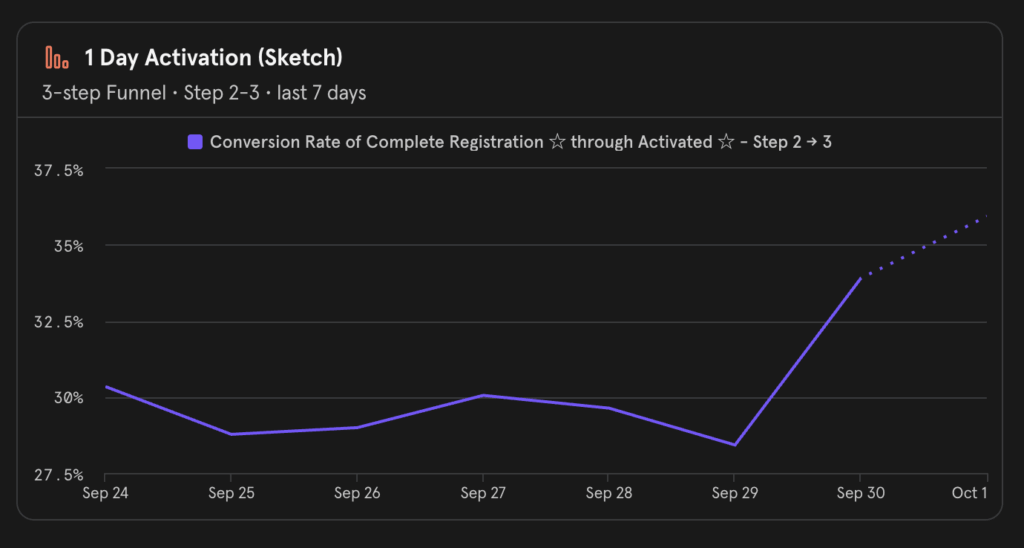
On October 1st, barely a week after the rollout, Chris shared:

A 5% activation lift, at Lumen5 scale, is massive. It meant more users weren’t just trying Chat to Video, they were engaging with the videos it created, taking actions like editing or downloading.
Current Exploration — “The Smartest Creative Starting Point”
Today’s experiments focus on:
- AI-generated media (Pixar-style animations, image→video transformations)
- Smart settings inference (“vertical, under 45s for TikTok”)
- Predictive defaults based on content, intent, and platform
- Unifying creation + editing into one intelligent chat input
Mac summarized the vision in internal notes:
“Moving toward prompt-driven inference: if users are vague, the system knows what to ask next without overloading them upfront.”
What the Feature Does (Walkthrough)
The workflow now looks like this:
1. You tell it what you want.
A prompt.
A URL.
A pasted script.
A PDF.
A half-formed idea.
A trending news topic.
Chat to Video reads it, analyzes it, and starts building.
2. It proposes a video plan.
Based on the input, Chat to Video decides:
- the narrative thread
- the tone
- the structure
- the pacing
- the visuals and media
If you didn’t specify a platform, it infers one.
If you didn’t specify a duration, it guesses based on content density.
3. It generates a preview — instantly.
This is the moment users tell us feels like “magic.”
Before touching a single menu, they see a moving video.
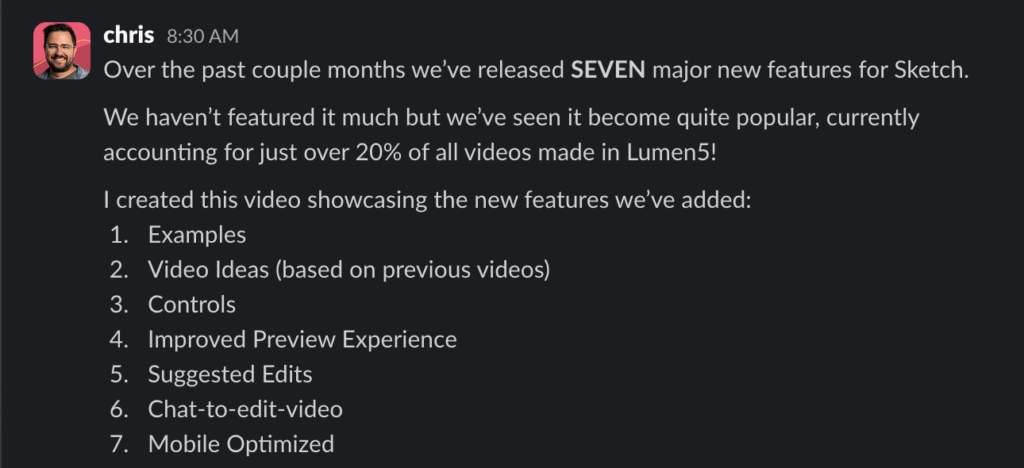
Back in early-November, Chris highlighted the range of improvements that now power this flow:
4. You iterate — by talking to it.
Some favourite real user-style edits:
- “make the intro punchier”
- “use AI voiceover instead”
- “try a more playful tone”
- “make three versions for LinkedIn, TikTok, and IG Reels”
- “shorter — like a teaser trailer”
Chat to Video responds instantly with a new cut.
A Slack message from Chris revealed how users began pushing the system:

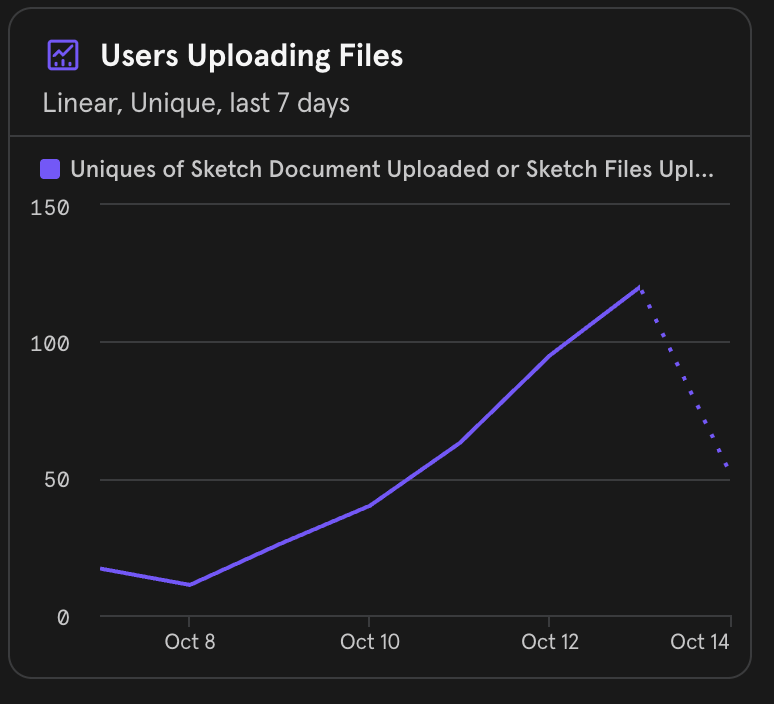
This told us users weren’t treating Chat to Video as just any tool. They were treating it as a full production assistant.
What’s Next + Why This Matters for Marketers
The Future of Chat to Video
The roadmap for Chat to Video isn’t about polishing a feature.
It’s about redefining Lumen5’s creative entry point.
Across internal threads, Notion docs, and Slack messages, a clear theme emerges:
👉 Chat to Video is becoming the starting place, not just a feature.
1. Smarter Chat → Editing + Creation Unified
Mac wrote early-October:
“I’d prefer to wait until we unify the regenerate and edit experiences before surfacing them in mobile… two chat inputs are confusing and cramped.”
This sparked a series of discussions:
Should chat be a creation tool or an editing tool?
The answer is now obvious: both.
In our Chat to Video Next Steps Notion doc, the team frames the direction like this:
- “Bundle Chat as a video edit tool.”
- “Guide the system on when to regenerate vs. when to apply video edits.”
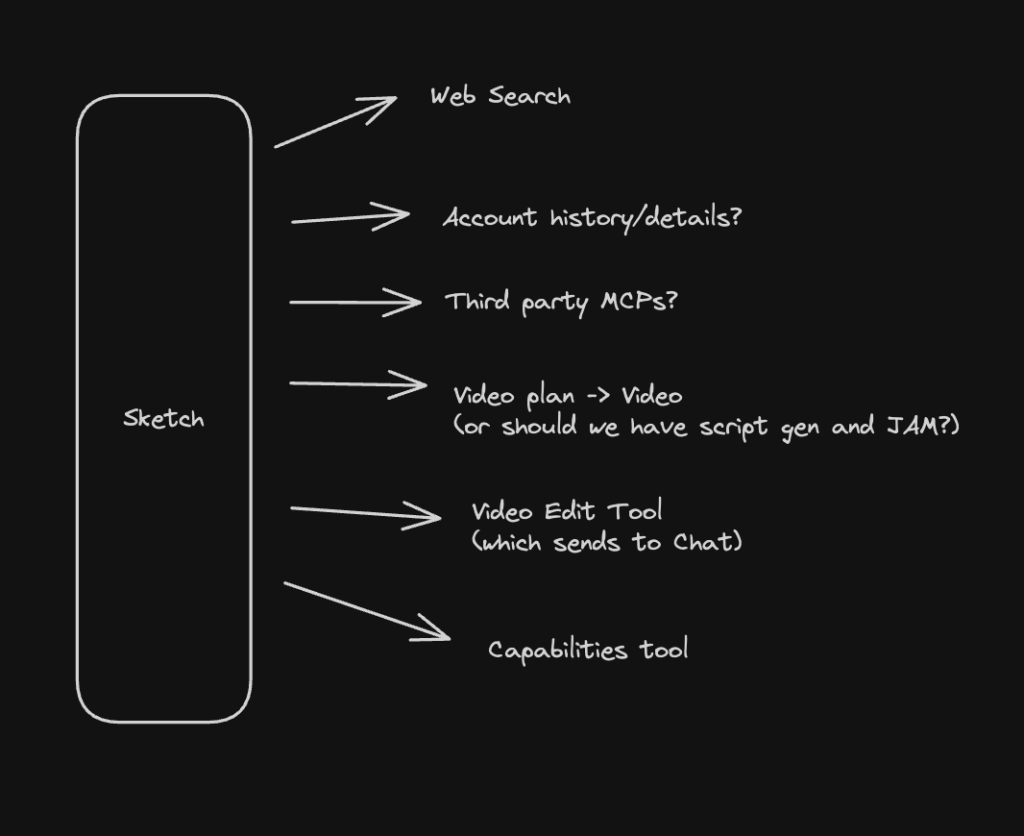
This is the beginning of a system that understands context, intention, and workflow — not just text.
2. Better Support for Uploads (Enterprise Priority)
One of the most consistent themes is enterprise needs:
- PDF ingestion
- Brand assets
- Talking head footage
- Long-form recordings
- Internal decks
This opens the door for large organizations to reconstruct complex internal assets into multiple video formats instantly.
3. AI Media: A New Canvas for Self-Serve Creators
Throughout October and November, Chris and the team repeatedly flagged the opportunity for AI-generated clips, animations, image-to-video, and stylized assets.
From a BTS Notion draft:
- “Integrating AI-generated media (Pixar-style clips, image → video transforms).”
- “Learn what you like — persistent chat memory.”
Imagine typing: “Generate an animated explainer for our new product update.”
…and Chat to Video building both the script and the visuals.
This is where Lumen5 begins to straddle the line between video editor and video engine.
4. Multi-Video Workflows (Campaign Creator Mode)
One of the most fascinating insights came from Chris mid-November, where he wrote:
“Users sometimes want more than one video from a piece of content… ask Chat to Video to make a series or multiple versions for different audiences.”
This is the seed of something bigger:
The Campaign Creator — a mode where creators generate an entire content package:
- A hero video
- 3–5 spinoffs
- Teasers
- Platform-specific cuts
All from a single prompt.
It’s already halfway there with Chat to Video-powered Spinoffs.
5. A Returning-User Model (Predictable, Personal, Smart)
Kaegan summarized this problem elegantly in the Notion notes:
“Right now it’s great for first-time users… but less good for folks who know exactly what they want.”
The team is exploring:
- Remembering user preferences
- Style consistency across sessions
- Using previous videos as learning data
- Persistent chat threads that evolve into a creative relationship
This is the heart of the long-term vision:
A creative partner that learns you.
Why This Matters for Marketers Right Now
2025 has been a year of uncomfortable truths in marketing.
Teams are being asked to deliver:
- more content
- in more formats
- for more channels
- at higher quality
- with fewer resources
In that landscape, Chat to Video hits four crucial needs:
1. Speed Without Sacrificing Quality
Marketers don’t want shortcuts — they want acceleration.
They want to get to the first draft faster so they can spend time on what actually matters: story, tone, brand, differentiation.
Chat to Video creates that first draft in seconds.
2. Lower Cognitive Load = Higher Creative Output
The best creative tools reduce decision fatigue.
Chat to Video removes the need to know:
- where the controls are
- what the right template is
- what the right duration should be
- what ratio works for TikTok vs YouTube vs LinkedIn
Chat to Video either infers the answer or asks at the right moment.
3. A Better Entry Point for AI-Hesitant Teams
AI is everywhere, but operationalizing it inside organizations is still messy.
Chat to Video gives teams a safe, guided, practical entry point:
- no AI jargon
- no complex workflows
- no multi-step agent orchestration
- no scripting skills needed
Just: “Make me a video about our Q4 results.”
4. Future-Proofing Creative Velocity
With AI media generation, campaign workflows, and iterative chat coming soon, Chat to Video is positioning Lumen5 not just as a video tool — but as a video system.
A place where marketers send ideas → and receive content.
A place where creativity scales with imagination, not headcount.
We began with a question: what if the first step in video creation could feel effortless? Chat to Video is our latest attempt at answering that.
If you want to see for yourself where that question led us, try Chat to Video in Lumen5 today and see how quickly your next idea can take flight. ✈️