

Marketing Strategy | Podcast
Somebody on your team generated something impressive last week. A first draft that came back in nine seconds instead of two days, maybe, or a set of localized variants that would normally have taken a contractor two weeks. Everyone in the Slack thread said “Whoa.” It went into the campaign.
Then a sales rep in another region noticed the spec was for the wrong product tier. Or legal asked where the customer quote had come from. Or a prospect replied and pointed out, politely, that your company does not actually do the thing the email said you do. Now three people are spending Thursday afternoon on a correction, the campaign is paused, and whoever generated the asset has quietly decided never to try that again.
That’s the shape of most AI failures in marketing. The work is rarely bad enough to catch in a skim and rarely good enough to survive someone who knows the subject, so it fails in front of a customer, where the cost is trust. Teams then swing to one of two bad answers: ban the tools, or stop talking about them.
Both leave you with no process and a team that hides its experiments.
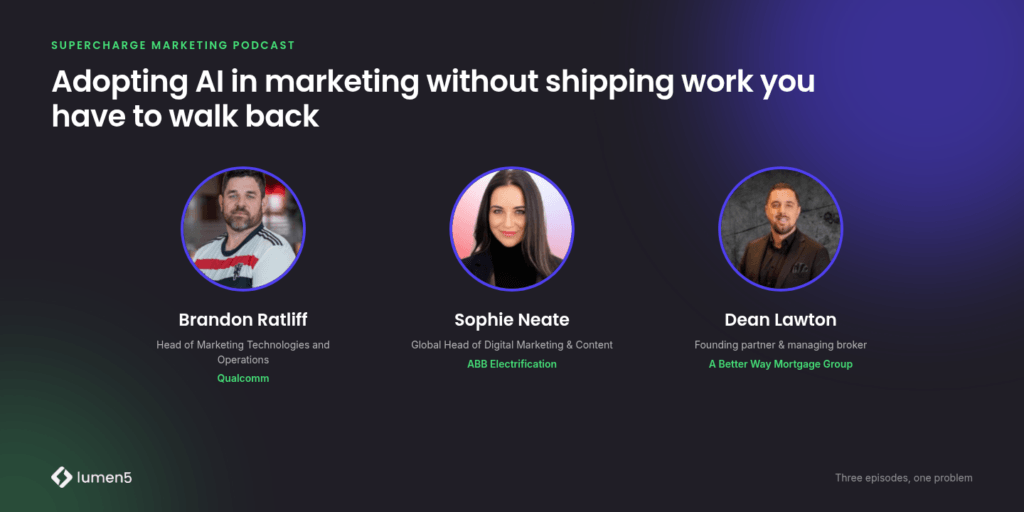
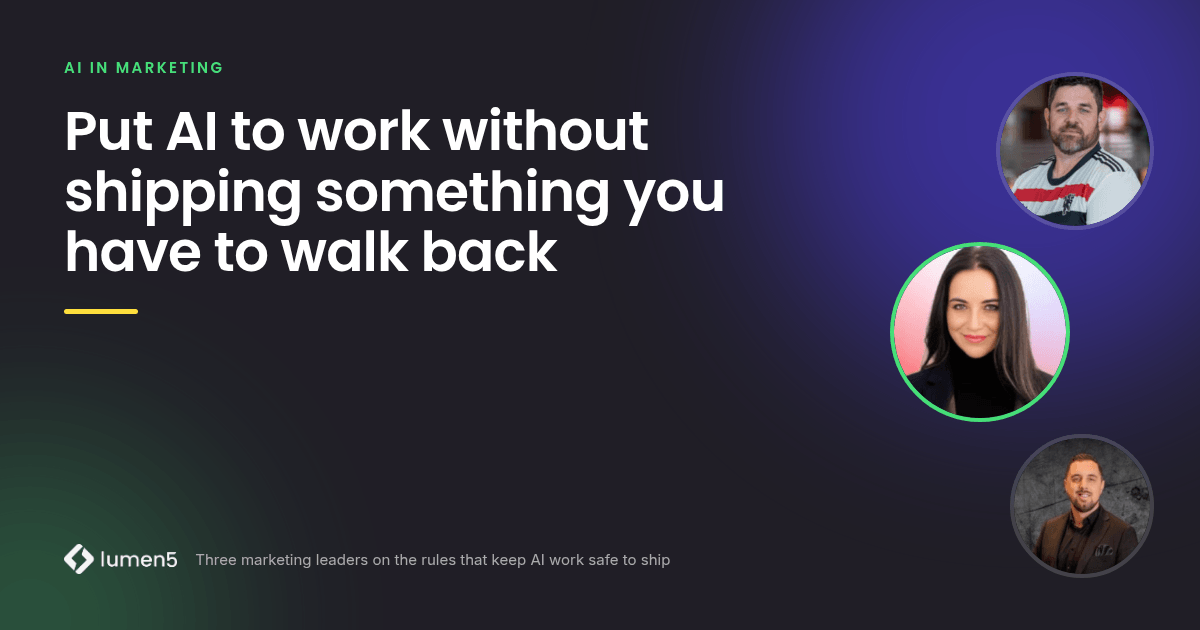
The same problem kept surfacing in three recent conversations on the Supercharge Marketing podcast, in three organizations that couldn’t be less alike. Brandon Ratliff is Head of Marketing Technologies and Operations at Qualcomm, running the MarTech stack behind a Fortune 100 portfolio. Sophie Neate is Global Head of Digital Marketing and Content at ABB Electrification, running campaigns across more than a hundred countries with buying cycles that stretch past a year. Dean Lawton is a founding partner and managing broker at A Better Way Mortgage Group, with over 450 brokers across Canada. All three have rules about where AI is allowed to touch the work, and the rules are more useful than the enthusiasm.
Clean the data before you point a model at it
Brandon’s team went hard at AI in 2025, enabling features across Adobe, 6sense, Qualtrics and anywhere else they could prove out value. What he is proud of is not the breadth, it is the restraint.
“We weren’t just playing with all these tools and releasing them into our MarTech stack willy-nilly style, but it was surgical.”
What makes surgical possible is boring, and almost everyone skips it. “If you’ve not done a good job stewarding your data from where it is to where it was to where it is today, you’re still gonna come up with the same sort of problems just on steroids,” Brandon says. Garbage in, garbage out, except now it arrives faster and reads more convincingly.
In practice that means common labeling and naming taxonomies, agreed before anyone writes a prompt and repaired quickly when someone documents something wrong. It sounds like housekeeping. It’s actually the failure mode. “As soon as we start using different words and different names and different labels for things, it can go really bad, really quickly,” he says. If half your team calls a field industry and the other half calls it vertical, a model will build segment messaging on a split that does not exist, and it will be articulate about it. Brandon’s bar for whether any of this is working is refreshingly low-drama: “If we can manage it and I can measure it, then we’re off to the races.” Not whether it impressed anyone. Whether you can see what it did.
Hand AI the operations, keep the judgment
Sophie’s team localizes content into more than a hundred markets, exactly the volume problem generative tools are built for. They use AI to produce it at scale, and never let it out unchecked.
“Although we utilize AI, we also utilize that human element to cross-check and fact-check every information,” she says. Every piece, not spot checks on the ones that feel risky. The reason is structural: their global-to-local model, which they call glocal, hands regional teams marketing kits to translate and adapt, so an error introduced centrally multiplies into every market that picked up the kit.
The second boundary is what the tools are allowed to see. ABB avoids putting sensitive information into external tools like ChatGPT, working instead through Copilot and their own in-house assistant, to keep customer data inside their GDPR perimeter. Decide that once and enforce it, because a busy marketer under deadline will paste the thing into whatever tab is already open.
What’s left for AI is still a lot. “We utilize AI as our ally, so to speak, to help us so we can focus on those strategic components, and AI will do the operational work for us,” Sophie says. Her team is researching how AI can sharpen lead qualification and prioritize accounts by intent signal, and she expects agentic AI to handle personalization across stakeholders. But the line doesn’t move:
“Insights will still be guided by humans to ensure compliance, ethics, and brand consistency are maintained.”
Brandon draws the same line from the other side. On data integrity, standards and cleansing, “sign me up today,” as he puts it. But his team has also fed tools everything they know, prompted carefully, and watched the output come back subtly wrong. When that happens they go back to bespoke content creation, because “the model isn’t there yet.” Knowing which jobs those are, for your business, is the actual skill.
(Listen to Brandon’s episode here)
Your best AI input is the content you already own
Dean’s team didn’t start with AI. They started with a podcast, and it turned out to be the asset that makes everything else possible.
One 30-minute recording with his partners or a guest becomes the full-length video, the audio episode, and a surprising number of clips. “We’re really sitting there for 30 minutes and we’re deriving content for two weeks from 30 minutes of our time,” he says. He calls it killing eight birds with one stone. AI helps at the preparation end, shaping a rough idea into a 45-minute conversation guide, and with the repurposing at the other end.
What makes it work is that the source material is genuinely his. The topics come from questions clients ask constantly: fixed versus variable, biweekly versus monthly, what happens with a subject-free offer. Each becomes a video with a blog attached, searchable by keyword, until the site is a catalog of answers rather than a brochure. Explaining the risks of a subject-free offer properly takes him about thirty minutes on the phone, and once the episode existed he could send the link instead. “That call would be two minutes max,” he says. “And to be honest, quite frankly, nobody would even take the call. They’d be like, wow, thank you, I got everything I needed.”
That is the version of AI efficiency that doesn’t blow up in your face, because the expertise in the output is real and yours. A model recombining your own recorded thinking is a very different proposition from one inventing a plausible answer about your product.
(Listen to Dean’s episode here)
Assume your buyer is checking whether a human was involved
Here’s the risk that doesn’t show up in a QA checklist. Your audience has started running its own detection, and it’s getting good.
Dean got a phone call recently from the landscaper who had worked on his house, and only clocked what he was talking to because of a sound in the background. “Why is the landscaper typing so aggressively?” he remembers thinking. He asked, and it confirmed it was AI.
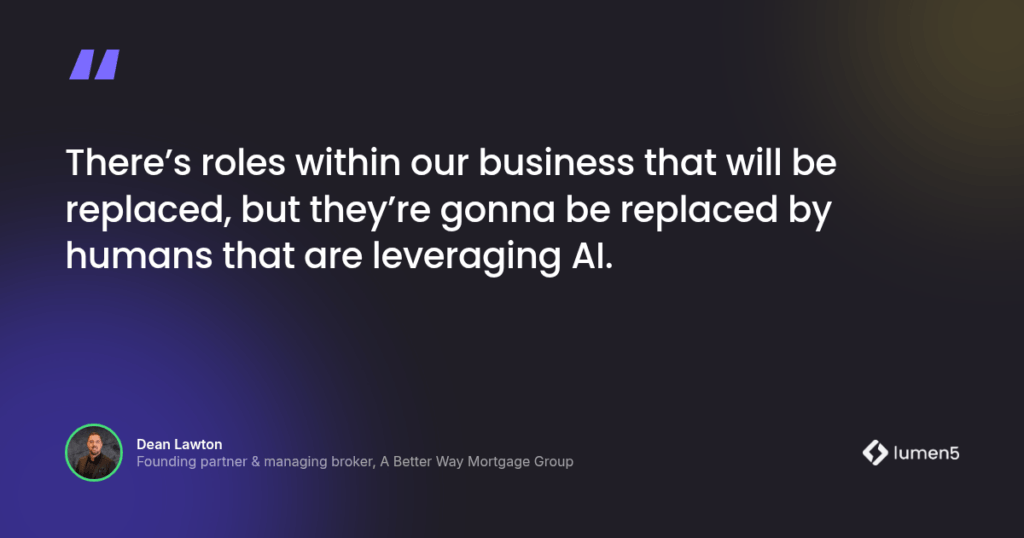
His conclusion isn’t that AI is bad. He thinks parts of his industry will be automated, and is direct about who wins: “There’s roles within our business that will be replaced, but they’re gonna be replaced by humans that are leveraging AI.” His concern is the question underneath, on what is the biggest financial decision most people ever make. Who programmed this thing, and “who’s looking out for my best interest?” A bank can program a bot to recommend the same five-year fixed product every time, cheerfully, at scale.
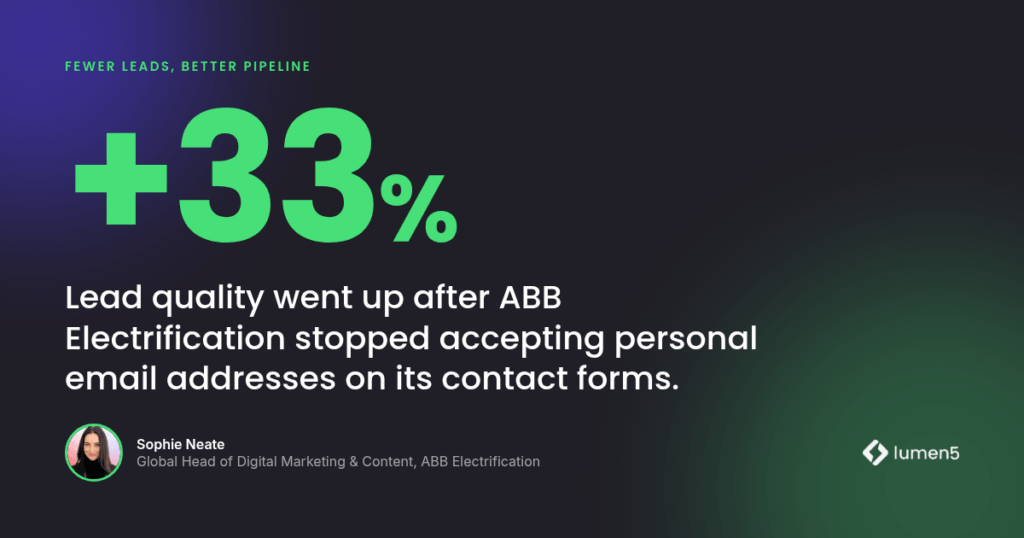
Sophie faces the same problem at enterprise scale, where the currency is transparency rather than personality. Roughly 80% of buyers do their research before they ever reach a company’s website, she says, and with ChatGPT and Google AI Overviews in the mix, many now do it without visiting at all. Her answer is to be useful before anyone identifies themselves: white papers, technical documents and brochures ungated during awareness, plus real participation in communities like Reddit, where peer recommendations carry weight and where AI systems are gathering their information anyway. Gating starts later, at consideration.
(Listen to Sophie’s episode here)
The takeaway
You don’t need an AI strategy this quarter. You need three decisions: which data is clean enough to feed a model, which outputs a human has to check before they reach a customer, and which number proves any of it worked. Make those, and your team can move quickly without spending trust you cannot get back.
Then go listen to the people who have already done it: Brandon on surgical AI adoption in the enterprise, Sophie on taking the friction out of the buyer’s journey, and Dean on content efficiency and AI-powered growth.
And when the volume of video your team is expected to produce goes up again, which it will, what protects you is control rather than speed. Lumen5 helps marketing teams turn the content they already own into polished, on-brand video, with brand kits, templates and shared workspaces so every video looks like your company made it, whoever on the team made it. See how it works, or book a demo with our team.the answer is anything other than a confident yes, Q3 is exactly the right time to change course.
Ready to dig deeper into what full-funnel B2B marketing looks like at global scale? Listen to the full conversations on the Supercharge Marketing podcast, available wherever you get your podcasts.
Listen on Apple Podcasts → https://podcasts.apple.com/us/podcast/supercharge-marketing/id1597823763
Lumen5 helps B2B marketing teams produce more video content faster and at a fraction of traditional production cost. Learn more or book a demo →