


Marketing Strategy | Podcast
Open your team’s shared drive and scroll back two quarters. There is a brand video in there that took six weeks, three rounds of stakeholder feedback, and a budget line somebody had to defend. There’s a webinar recording with a viewership number nobody’s mentioned since. There’s a product one-pager that sales has never once attached to an email, and a customer interview transcript that got read exactly one time, by the person who ran the interview.
None of it was bad work. That is the uncomfortable part. It was researched, designed, approved, and published, and then it stopped. Meanwhile your roadmap for this quarter asks for more of the same: more assets, more channels, more velocity. So you make more, and the folder gets bigger, and the honest measure of your team’s output is not how much you produced but how much of it is still doing anything.
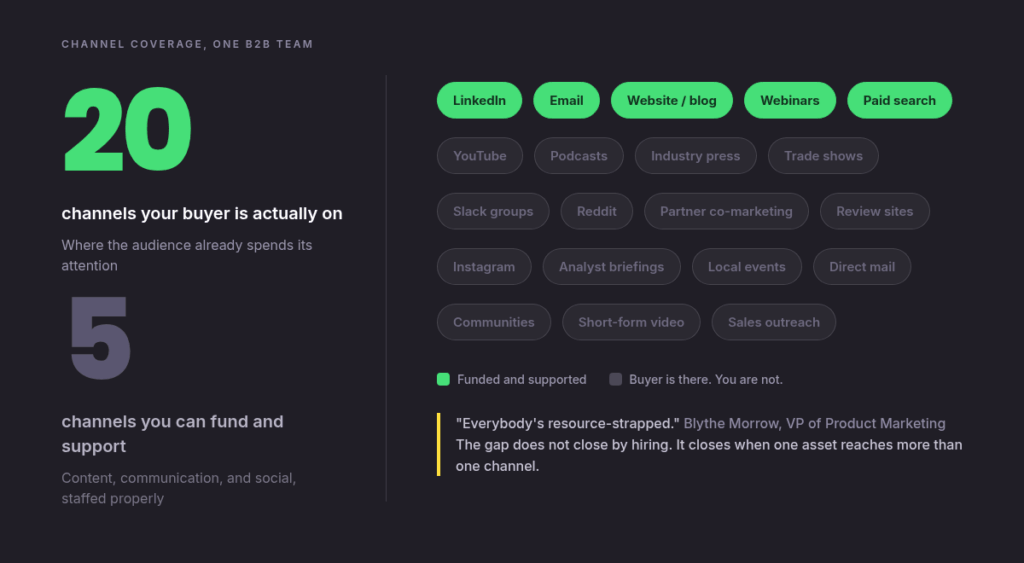
That gap costs real money, and it is easy to hide. A single brand video can eat five figures before it reaches a feed. Blythe Morrow, VP of Product Marketing, puts the channel math bluntly: your buyer might be active on twenty channels, but “you can only fund and support the content and communication and the social aspect of five of them.” Everything you make for the other fifteen is being asked to travel further than one publish button can carry it. And most teams never build the plan that would carry it, because “make more” is a clearer instruction than “make it work harder.”
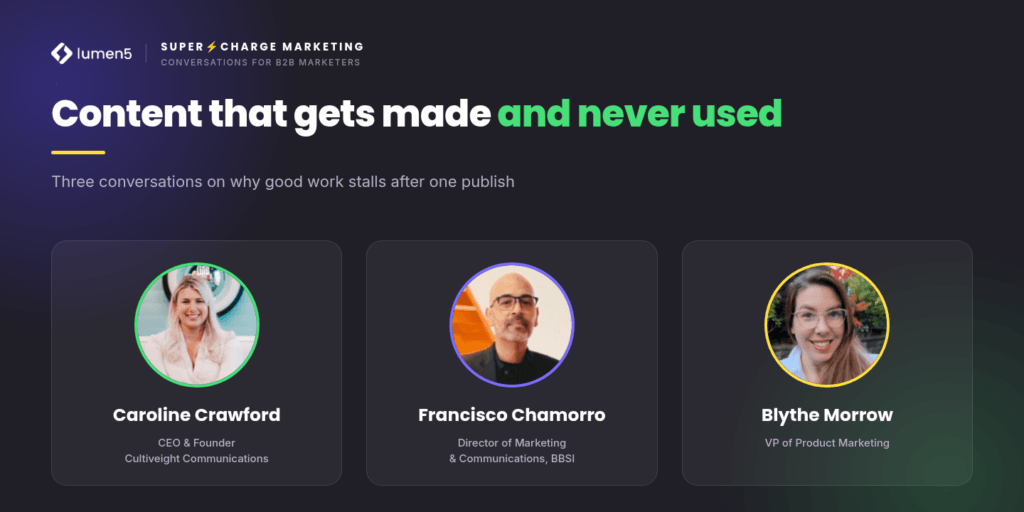
This same problem came up in three recent conversations on the Supercharge Marketing podcast, from three people who approach it from completely different angles. Caroline Crawford, CEO and Founder of Cultiveight Communications, spends her days rebuilding content strategies for B2B teams that have been producing steadily and converting slowly. Francisco Chamorro, Director of Marketing and Communications at BBSI, runs internal and external comms for an HR and payroll services business and treats content distribution as an operations problem. And Blythe Morrow has spent seventeen years in product marketing leadership, mostly deciding which words a whole company uses to describe itself. Here is what they would change.
Decide how a piece of content will be used before you decide to make it
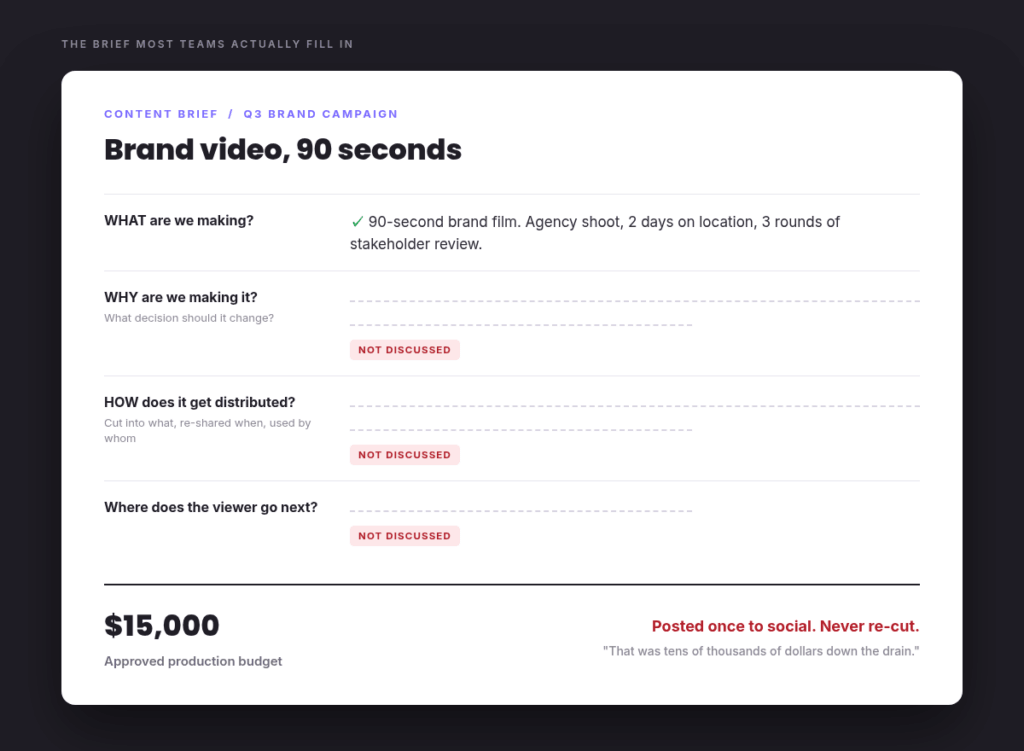
Caroline’s diagnosis of the average content meeting is uncomfortably accurate. “It’s always about the what and not really enough conversation around the why or how is it going to be distributed,” she says. A team debates whether to do brand videos, or ads, or blogs. Nobody debates what happens on day two.
She’s watched the ending of that story more than once. A company spends fifteen thousand dollars on brand videos, posts them to social, and then, in her words, “that was tens of thousands of dollars down the drain.” The failure was not the video. The failure was that the entire budget and every hour of energy went into finishing it.
“All of that resource or so much of that energy was created to getting that done, that they think that that’s gonna just win it all,” she says. “When it’s not that actual thing. It’s how you’re applying it and it’s how you’re maximizing your investment to it.”
– Caroline
The fix is a planning step that costs nothing and is skipped almost universally: before production starts, map how the finished asset gets torn apart. One long article becomes the source for a lead magnet, a nurture sequence, a set of social posts, and a video. One recorded conversation becomes weeks of material. Caroline describes it as repackaging content into “little morsels that tell your story in different ways,” and the point of mapping it in advance is that repurposing shapes what you shoot, write, and structure in the first place.
Listen to Caroline’s episode here>
Francisco arrives at the same rule from the operations side. His advice to his younger self: “if you’re going to build something, build it to be repeatable first before you scale it.” Over-engineer a single massive launch and you get one launch. Build a format your team can run again, and the second one costs a fraction of the first.
Assume nobody saw it the first time
Most content is retired after one publish, on the quiet assumption that the audience saw it and moved on. Francisco thinks that assumption is simply wrong.
“If you’re spending time and you value that piece, just know that it’s not going to get seen a hundred percent of the time the first time that it’s out there,” he says. “So it’s important to re-share it.”
– Francisco
He describes the experience everyone has had and nobody plans around: an algorithm surfaces a post weeks late, and it reads as new because you genuinely never saw it. His conclusion is that a team’s job is “to give your content the biggest life support it can have.”
That means treating cadence as part of the asset, not as a nice-to-have. Francisco applies the same framework internally and externally, and the ingredients are consistency plus relevance: “People like repetition.” Communications land on a predictable day, so the audience develops an expectation. And the calendar gets edited by data rather than by opinion: “When we create a topic and it works well, we do more of it. When we create a topic and it doesn’t work well, we drop it.”
Listen to Francisco’s episode here >
Caroline’s caveat is what keeps this from turning into spam. She sees B2B teams so worried about being noise that they publish once every other month and starve their own funnel. Her position is that noise is a function of sameness, not frequency: “as long as you’re creating with intention, it shouldn’t be noise.” Repeat the same message in the same format and people tune out. Repeat the same message repackaged, and it reads as new. That is also why the mapping step in the last section matters so much. A team that planned six formats up front has six legitimate ways to say the thing again.
Build your source material in a room with twelve customers
Blythe’s answer to “what should we make next” is to stop guessing in a document. Product marketers, she says, “get very, very wrapped inside of our own echo chamber,” and then they “play this telephone game with sales,” where a seller relays customer feedback to marketing, and marketing relays it to product, and the original words are gone by the second hop. Her prescription is unglamorous: get out of the office, stand on an exhibition floor, make friends with your sales team, and ask to sit on sales calls.
The mechanic she has built around this is worth copying directly. Instead of running a webinar, which she describes as “a lecture, a one-to-many lecture where I put up a PowerPoint and I’m talking and someone’s, you know, everybody’s cameras are off and they’re emailing while they’re also trying to listen to me,” she runs small workshops. Roughly twelve people. Cameras on. An honest conversation about what is actually happening in their industry, not a product pitch. Product managers and customer success sit in and listen.
Run that regularly and the numbers add up faster than they look: 150 to 160 people a year you have had a real conversation with, who then populate your LinkedIn and Slack communities and amplify your message in public. One salesperson gets assigned per roundtable, and the follow-up call is warm, because, as Blythe puts it:
“they’re much more likely to pick up the phone and have a chat with you because you’ve already demonstrated that you value them.”
– Blythe
And the content problem solves itself as a side effect. Each workshop, she says, “creates incredible content for you to then give to the demand generation team to cut up in 100 different ways and to seed a lot of the campaigns that we’re trying to run congruently.” Source material built from real customer language is the kind that gets used, because it already sounds like the market.
Listen to Blythe’s episode here > **Worth an hour of your commute:**
If sales won’t use it, it’s not content. It’s inventory.
Here is the fastest way to find unused content: look at what your sales team attaches to emails, and compare it to what you shipped. Francisco is direct about the priority order. “I don’t care how cool your video or campaign is, your internal users have to buy into it first,” he says. “If they don’t, it’s not going to be successful.” That is not modesty about marketing’s role. A beautifully produced asset with no internal adoption has an audience of zero, which is why “spending that time and that effort to make sure that what you’re doing is helping your sales team is critical.”
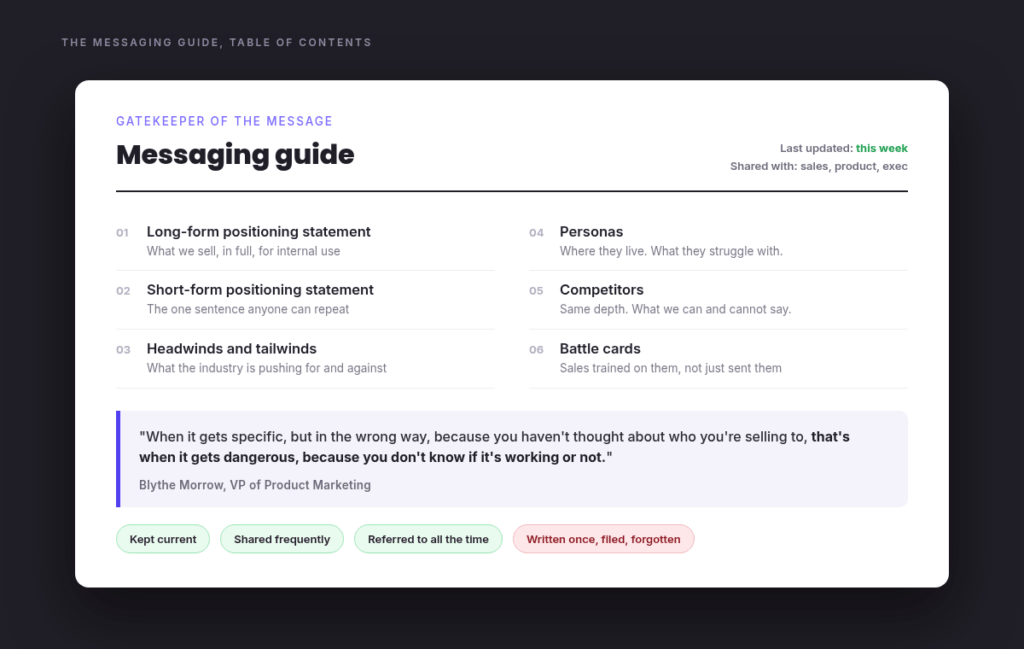
Blythe agrees on the destination and gets specific about the vehicle. Product marketing, in her framing, is “the gatekeeper of the message, the words that we use to describe what we’re selling,” and the artifact that makes that real is a messaging guide detailed enough to be worth opening. Hers covers the long-form positioning statement, the short-form positioning statement, the headwinds and tailwinds of the industry, every persona (where they live, what they struggle with), and the same depth on competitors. Then the part most teams skip: “keeping it current, sharing it frequently, referring to it all the time and continuing to add to that library.”
She also names the failure mode that is worse than vague messaging. Confusing copy at least announces itself. “When it gets specific, but in the wrong way, because you haven’t thought about who you’re selling to, that’s when it gets dangerous,” she says, “because you don’t know if it’s working or not.” That is the asset that gets made, gets approved, gets published, and quietly underperforms for a year while everyone assumes the channel is the problem.
Fix the path back before you publish anything else
Content that never converts isn’t always unused. Sometimes it is seen and then dropped, because there is nowhere for the reader to go. Caroline’s version of the question: you posted the repurposed clips, so “what is that journey to come back to you?” If you’ve not built the route from the public channel to your site, your trial, or your sales team, “then you’re kind of doing it as you go,” and that is where the cracks appear.
She is equally blunt about the order teams work in. “I think people do it backwards,” she says. “They’re like, oh, let me get this lead magnet up, and then I’ll figure the email out later.” Reverse it. Decide what the email programme is for, then build the lead magnet that feeds it. Her underlying principle applies to every step of the path: “the more brain power that it requires on them to do what you want them to do, the less they’re gonna do what you want them to do.”
The same discipline belongs on your tech stack, and this is where Francisco is most useful. He sees two pitfalls in almost every team: “One is that they let tools drive their strategy. And then the other one is that they don’t fully utilize their tools to the full capacity.” Before you buy anything else, he suggests one question: “if you’re paying for a piece of software, definitely ask yourself, am I using it to the fullest?” And on the integrations everyone builds because they can, his rule is a good one to write down: “integration for the sake of integration is not where I would spend my effort.”
Blythe would add that none of this is a resourcing failure to be ashamed of. “Everybody’s resource-strapped,” she says. The teams pulling ahead are not the ones with more people, but the ones whose existing work reaches more of the channels their buyers are on.
What to do with this
Don’t start by planning your next asset. Start by auditing the last quarter’s. For each piece, ask three questions: was it re-shared after week one, did sales ever use it, and was it ever cut into a second format. Anything scoring zero on all three is not a content problem. It is a distribution and adoption problem, and making a fresh one will not fix it.
Then pick one asset that deserved better and give it the second life it never got. For the full conversations behind all of this, listen to Caroline Crawford on Intentional Marketing for Scrappy Marketers, Francisco Chamorro on The Science and Art of Marketing, and Blythe Morrow on How Product Marketing Shapes Strategy From Messaging to Sales Alignment.
Turning one asset into many is exactly the part Lumen5 is built for. Teams use it to convert the articles, transcripts, and documents they already have into polished video, with brand kits that keep colours, fonts, and logos consistent no matter who on the team is making it. That means less time rebuilding from scratch, and more control over how your brand shows up across every channel. See how it works, or book a demo with our team.
Ready to dig deeper into what full-funnel B2B marketing looks like at global scale? Listen to the full conversations on the Supercharge Marketing podcast, available wherever you get your podcasts.
Listen on Apple Podcasts → https://podcasts.apple.com/us/podcast/supercharge-marketing/id1597823763
Lumen5 helps B2B marketing teams produce more video content faster and at a fraction of traditional production cost. Learn more or book a demo →