



Marketing Strategy | Podcast
You’ve written the page four times now.
Version one was clear, and the subject matter expert sent it back with six corrections and a polite note that you’d oversimplified “the part that matters.” Version two was accurate, and it read like a washing machine manual. By version three, you’d stopped writing sentences to be understood and started writing sentences to survive review. Now you’re staring at a paragraph nobody will object to and nobody will finish.
Welcome to marketing something complicated.
You sit between people who know too much and people who don’t know enough, and both of them hold a veto. The experts think you’ve flattened their life’s work into a greeting card. The audience thinks you’re hiding something. Split the difference and you get copy that’s technically correct, emotionally flat, and about as memorable as a terms of service update.
Have you read the terms of a service update? *Yawn* 🥱
This exact problem came up in three recent conversations on the Supercharge Marketing podcast, with three people who explain hard things for a living:
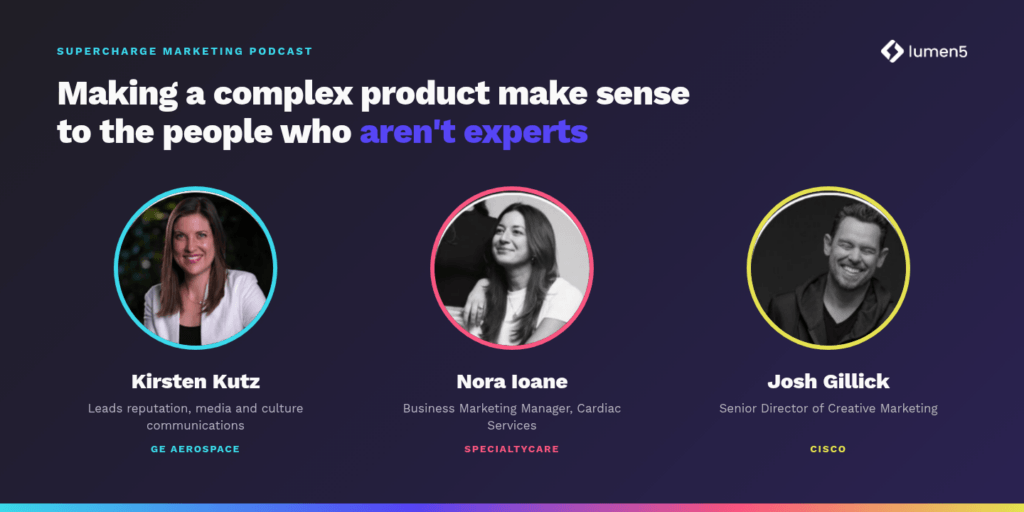
- Kirsten Kutz leads reputation, media, and culture communications at GE Aerospace, where the product is an aircraft engine and the audience runs from procurement teams to passengers.
- Nora Ioane is Business Marketing Manager for Cardiac Services at SpecialtyCare. She taught high school English for eight years before she ever wrote a marketing email.
- Josh Gillick is Senior Director of Creative Marketing at Cisco, where his team has to make networking equipment look like something.
Here’s what they taught us. 🧑🏼🏫
Your expertise is the thing standing between you and your reader
Kirsten’s secret weapon at GE Aerospace? She’s new to aviation. She’s been with GE for years, but only a couple of them in this industry, and instead of hiding that, she treats it as an asset.
“I’m able to bring more of an outsider’s eye,” she says. The leaders around her can’t, because they’re so deep in the technology that “they don’t see that from the outside it could be a little bit too complex.”
Here’s the uncomfortable part: this trap doesn’t loosen with seniority. It tightens. The longer you’ve lived with something, the harder it is to spot which parts need explaining, because none of them need explaining to you. It’s like trying to judge whether your own handwriting is legible.
Nora’s fix is to never be the only person who reads a message before it goes out. She keeps a small panel of reviewers with deliberately different jobs: someone from operations, someone from sales, a clinician. They’re not there to approve. They’re there to catch what she can’t see.
“There might be something that has a bit of nuance that I’m not privy to that someone else in the company would know,” she says. A sentence that looks harmless to a marketer can land very differently with someone who works a hospital floor every day.
What we love is that she says the quiet part out loud. “I don’t have the healthcare background here,” she tells her team. That’s not a confession. It’s the reason her copy is readable.
Simplify for the audience, not for the topic
“Use plain language” sounds like a rule you apply evenly, like a coat of paint. It isn’t. It’s a call you make for each audience, and you can get it wrong in both directions.
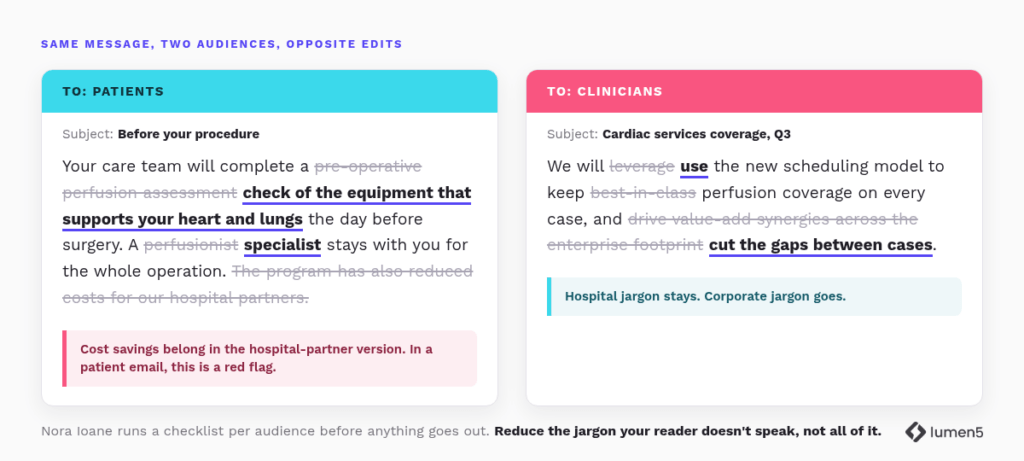
Nora calls it code switching, and she means it literally. “If we’re sending something out to patients, then reducing the amount of hospital jargon is going to be very important. If we’re sending something out to clinicians, then reducing the amount of corporate jargon is going to be very important.”
Same organization. Same service. Opposite edits.
She runs a quick checklist for each audience, and it catches real problems. Language about reducing costs in a message for patients? Red flag. Cost savings matter a lot to a hospital partner. To someone reading it before surgery, it’s frightening.
She also has a sharp take on why jargon sneaks in at all: it’s a status move. “While it might make the speaker feel elevated, you run the risk of losing your audience.” The fix: “you have to make sure that you prioritize the receiver over yourself as the sender.” Feel free to print that and stick it to your monitor.
Kirsten’s world looks like the opposite and proves the same point. Her buyers are airlines, and they know engines better than most of us know our own phones. “I don’t necessarily have to simplify for that level of decision maker,” she says. Simplify for that room and you’re not being clear, you’re being condescending.
What she adjusts instead is emphasis. Customers in the Middle East want to hear about durability, because it’s hot, sandy, and dusty. That’s a different conversation from the one she’d have in North America.
So the question was never “how simple should this be?” It’s “what does this audience already know, and what do they actually care about?”
Start with the ending and work backwards
Nora’s method came straight out of the classroom. Teachers call it backwards planning: pick the objective for the term, then work back through how to chunk and build the material so students get there.
She writes communications the same way. “I will carefully consider my audience first. What is it that I want my audience to take away from this message, what’s the end goal, what’s the objective here.”
After that, the job is mostly deleting. No filler, nothing the reader has to carry that doesn’t serve the goal. In healthcare, she points out, people are lucky to have time to glance at their email at all. (Honestly, so is everyone else.)
Josh uses the same logic on a tougher crowd: an executive who multitasks through every creative review. Since he knows what she cares about, he puts all of it up front. He shows the list of everything she asked for and marks off what made it in. He names the five things that didn’t, and why they weren’t working in the story. He walks through the storyboard. Then he turns everything off and reads the script aloud, and she stops and listens.
Compare that to the classic agency move: hold everything back and build to a big reveal. Josh has watched it fail, and he knows exactly why. “You haven’t given this person a spot, a place of comfort yet. You haven’t told them that we’re going to give you exactly what you asked for.”
If your audience is still scanning for the thing they asked about, they’re not hearing your story. Reassure first. Dazzle second. ✨
The expertise gap runs both ways
Most advice about explaining complex things assumes you’re the expert and everyone else is confused. Josh flips that around. The people sending you requests are experts too, just in something else, and they’re just as blind across the gap as you are.
The most common complaint on his creative team is product marketing requests that don’t make sense. His response is refreshingly blunt: “You cannot do their job. Flat out.” Then comes the part that stings: “If the flow of information was reversed, they’d be complaining about all the same things.”
Which makes the real job pretty clear. “Our job in creative, not only to pull a good brief out of someone, but is to educate,” he says. “Always educating about what we do and why we do it.”
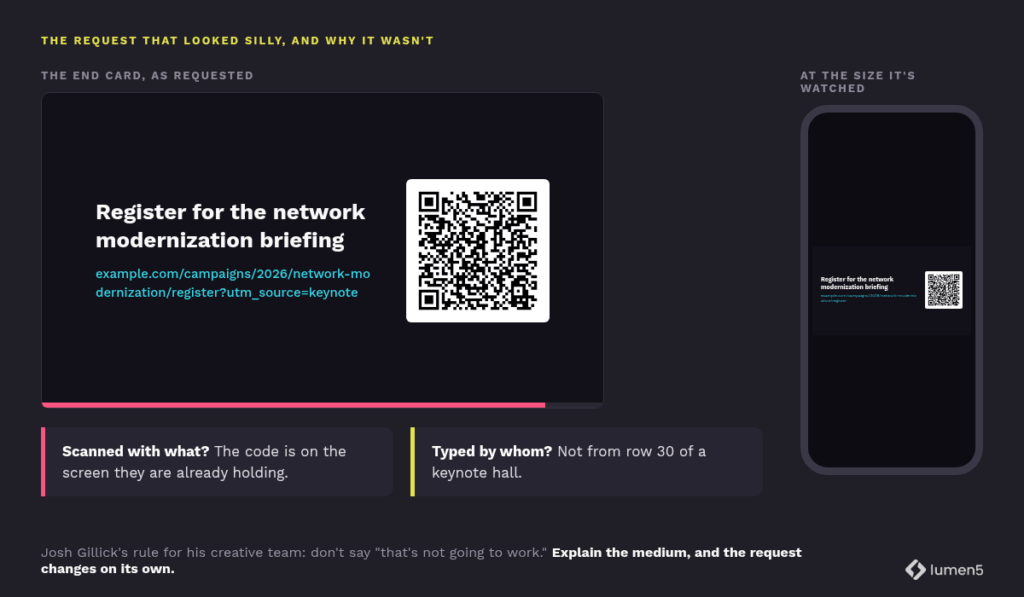
Saying “that won’t work” doesn’t count. As Josh puts it, “it may help our ego a little bit to feel like we are important in our role, but it’s not making our requesters partners in the project.”
Here’s what that looks like in real life. Someone asked his team to put a long URL and a QR code at the end of a video. The team’s first instinct was an eye roll. The better move was to explain the medium. Most people watch video on their phones, so they can’t scan a QR code on the very screen they’re holding, and nobody’s typing out a long URL while watching a keynote. Once you explain that, the request fixes itself. The requester wasn’t being unreasonable. Video just isn’t their medium, and nobody had told them.
And Josh is honest about how long this lasts. “We are going to be educating about what we do forever. It’s not just once, not just twice.” Not a workshop. Not a one-pager. Forever. Pack snacks.
If your product is invisible, put down the stock photo
Some products are hard to explain because they’re technical. Others are hard because there’s literally nothing to look at.
Josh markets networking equipment, and you already know the default visual: glowing abstract lines zipping across a night sky. “Stock websites are chock full of that stuff,” he says. “And it looks generic.”
That’s his team’s live challenge, and it’s a great test for anyone selling something abstract. Can you show your product’s value in a way that isn’t interchangeable with every competitor’s? His whole team is experimenting on real projects instead of running a pilot tucked away in a corner. The constraint he keeps coming back to is accuracy. Cisco sells hardware, and it has to look right every time, at the right size and scale, or the product team will have notes.
He’s just as clear on what doesn’t count as a story. An executive once sent his team an AI-generated image they loved. Josh’s verdict: “It’s not great storytelling. It’s not on brand.” Novelty was doing all the work.
His standard is the opposite of a novelty flex: “How do we make certain you don’t know what tool we used to make it?” Or, more bluntly: “I’m not making commercials to promote that I made them with AI.”
Kirsten arrives at a similar place from the writing side. She’s a writer by trade, and she’s watching text lose its grip on people. “There’s just so much of it now,” she says. “And you don’t know if the person posting it is actually writing it.”
For audiences small enough to count, live and personal beats mass written communication, with video sitting usefully in the middle. That’s not a format trend. A real human on camera is a lot harder to fake than a paragraph.
Say the same few things until you’re bored of them
Kirsten and Nora landed on the same discipline, and it’s the least glamorous idea in this whole post. Stay with us anyway.
Kirsten’s version: figure out “the two or three key things that are not going to change,” then adapt everything else around them. That fixed core is what makes local tweaks safe, because the fundamentals never move. It’s also how trust builds. “Trust in any kind of relationship is about consistency,” she says.
Nora’s version comes from teaching. “You can never give somebody information once and expect them to master it.” Her checklist isn’t just a quality check on one message. It’s what creates a pattern across many. Stick to the same three priorities for a quarter and you get something no single email can deliver: “If you look back on all the messages from this past quarter, you see a theme of reassurance.”
She also shared her hardest-won lesson, and it’s a good one. The urge to keep adding more isn’t generosity. It’s nerves. When she over-explained to her students, “it made them feel like I didn’t trust them to be smart enough to receive a base level explanation.”
Busy adults react the same way, and she’s candid about where the habit comes from: over-explaining “has something to do with an insecurity for me.” Brave thing to say on a podcast. Even braver thing to fix in your copy.
Your Monday homework (it’s short, we promise)
Grab the next thing you’re about to publish and do two things to it: ✅
- Send it to one person whose job isn’t yours. Ask what’s confusing, not whether they like it.
- Cut the paragraph you added out of worry that someone might think you’d left something out. That’s usually the one making you sound like you don’t trust your reader.
That’s it. No framework. No 40-slide deck.
Keep the conversation going
All three conversations are worth a listen:
- Kirsten Kutz on building trust and clarity in complex B2B markets
- Nora Ioane on what teaching taught her about trust and attention
- Josh Gillick on leading creative teams in the age of AI
And when the clearest way to explain your product is to show it, that’s where we come in. Lumen5 turns what your team already has, whether that’s a blog post, a script, or a set of talking points, into on-brand video, with your fonts, colors, and logo locked in. That way everything your team ships looks like it came from one company, not five slightly different ones.
Head over to lumen5.com to see how it works, or book a demo and we’ll walk your team through it. We’d love to help you make the complicated stuff click.
Listen on Apple Podcasts → https://podcasts.apple.com/us/podcast/supercharge-marketing/id1597823763
Lumen5 helps B2B marketing teams produce more video content faster and at a fraction of traditional production cost. Learn more or book a demo →
Frequently asked questions
How do you explain a complex product without oversimplifying it?
Start with what your audience already knows and what they care about, rather than how simple the topic can get. On the Supercharge Marketing podcast, Nora Ioane of SpecialtyCare described deciding the reader’s key takeaway first and then cutting everything that doesn’t serve it. Then send the draft to reviewers from different teams, like operations, sales or clinical staff, so they can flag nuance you missed. Clarity comes from choosing what to leave out, not from dumbing anything down.
Why do subject matter experts struggle to write clearly for non-experts?
Experts live so close to their subject that they can’t see which parts are confusing, because nothing confuses them. This is often called the curse of knowledge, and it gets stronger with seniority. Kirsten Kutz of GE Aerospace told the Supercharge Marketing podcast that being newer to aviation gives her an outsider’s eye. Leaders deep in the technology often don’t notice when something looks too complex from the outside. A newcomer or a reviewer from another team is usually the fastest fix.
How should marketers adjust jargon for different audiences?
Treat plain language as a decision you make for each audience, not a blanket rule. Nora Ioane calls this code switching. For patients, she strips out hospital jargon. For clinicians, she strips out corporate jargon. She also checks for messages that land differently depending on the reader: cost savings excite a hospital partner but can frighten a patient before surgery. Meanwhile, Kirsten Kutz notes that airline buyers already know engines deeply, so simplifying for them would come across as condescending.
What is backwards planning in marketing communications?
Backwards planning is a teaching method where you start with the end goal and work back to the steps that get you there. Nora Ioane, a former high school English teacher, applies it to marketing. Before writing, she defines what the audience should take away and what the message needs to achieve. Then she removes filler and anything the reader doesn’t need. It works especially well for busy audiences who only have time to glance at an email.
How can creative teams get better briefs from product marketing?
Educate requesters about the medium instead of rejecting requests. Josh Gillick, Senior Director of Creative Marketing at Cisco, told the Supercharge Marketing podcast that pulling a good brief out of someone and educating them are both part of creative’s job. His example: a request to put a long URL and a QR code at the end of a video. Most people watch video on their phones, so they can’t scan a code on the screen they’re holding. Explaining that turns requesters into partners, and Gillick says the education never stops.
How do you present creative work to a busy executive?
Lead with reassurance. Josh Gillick shows the executive’s original requests first and marks off what made it in. He names what didn’t and explains why it didn’t fit the story. Then he walks through the storyboard and reads the script aloud. Holding everything back for a big reveal often fails, he says, because the executive is still scanning for the thing they asked for and isn’t listening to the story yet.
How do you market a product that’s hard to visualize?
Avoid generic stock imagery and look for visuals that only your product could own. Josh Gillick points out that networking visuals usually default to glowing abstract lines, which make every brand look the same. His team experiments on real projects while keeping hardware accurate in size and scale. His bar for AI-assisted visuals is that viewers shouldn’t be able to tell which tool made them. Novelty alone isn’t storytelling.
How do you build trust when marketing complex B2B products?
Build trust through consistency. Kirsten Kutz recommends identifying two or three core messages that won’t change and adapting everything else around them, such as emphasizing durability for customers in hot, dusty regions. Nora Ioane adds that people rarely absorb information the first time, so repeating the same priorities across a quarter creates a theme readers recognize. She also warns that over-explaining can signal you don’t trust your audience to understand.
How can video help explain complex B2B products?
Video lets a real person explain an idea, which is harder to fake and easier to follow than another block of text. Kirsten Kutz notes that audiences are overwhelmed by written content and unsure who actually wrote it. Lumen5 helps B2B marketing teams turn existing blog posts, scripts and talking points into on-brand video, with fonts, colors and logos locked in, so complex messages stay consistent across every team and market.