



Marketing Strategy | Podcast
Think about the last thing your company sold that the buyer couldn’t try first. No free trial. No sandbox account. No “just click around and see how it feels.” We’re talking about a surgical service, a five-year banking relationship, a consulting engagement, or a piece of infrastructure that only proves itself eighteen months after someone signs for it.
They signed anyway. So what exactly did they buy?
Not the product. They couldn’t inspect it. They bought everything around it: how clearly your website explained what happens next, whether the person on the call could answer a follow-up without promising to “circle back,” and whether your case study sounded like a real customer or like your marketing team wearing a customer’s name tag.
When people can’t judge the thing, they judge the signals around the thing. Every one of those signals is something your team either got right or got wrong. That’s a lot of weight for a FAQ page to carry, and most teams carry it without ever noticing it’s there.
The short version: When B2B buyers can’t evaluate a product before they commit, they decide based on proxy signals. Three guests from Lumen5’s Supercharge Marketing podcast share how to get those signals right:
- Swap claims about yourself for customer voices and evidence (Meghan McNamara calls them “receipts”).
- Run every capability through the “so that” test, so features always arrive with a consequence attached.
- Cut the padding, because readers treat fluff as a reason to distrust you.
- Put every message in front of reviewers who don’t think like you.
- Measure brand trust over years, not weeks.
The trust bar got higher this year (and it wasn’t exactly low before)
Gartner’s May 2026 survey found that 69% of B2B buyers now prefer to validate AI-generated insights with a sales rep, and 51% think they’re more likely to run into misleading information from generative AI. Meanwhile, TrustRadius’s 2026 buyer study found the share of buyers who say they trust online resources less than they used to jumped from 39% to 47% in a single year. And vendor marketing collateral? Dead last on the list of things buyers actually consult.
Ouch. 🤕
Buyers aren’t getting lazier. They’re getting more suspicious, faster, and with far less patience for anything that doesn’t survive a quick sniff test. Which means the classic move of announcing, loudly and confidently, that you’re the trustworthy option now works against you. Confidence is the cheapest thing in the market right now. Any chatbot will hand you a paragraph of it for free.
This exact problem came up in three recent conversations on the Supercharge Marketing podcast, from three people who sell things nobody can inspect in advance.

Meghan McNamara leads product marketing and go-to-market for Deloitte’s Government and Public Services practice, where the product is other people’s expertise. Jan Liebchen is SVP and Head of Marketing at M&T Bank, where every competitor sells the identical checking account. And Nora Ioane is Business Marketing Manager for Cardiac Services at SpecialtyCare, where her reader might be a surgeon with four spare minutes or a patient about to have their chest opened.
None of their buyers can try before they buy. All three have figured out what to give those buyers instead.
Stop saying you’re trustworthy. Let someone else say it.
Jan starts from a position most marketers would call a nightmare. “We’re dealing with a commoditized product,” he says, and he means it literally. A checking account at M&T does what a checking account does everywhere. There’s no killer feature to brag about and nothing shiny to put in front of a customer.
So he gets out of the way.
“It’s really easy to say, you know, I’m trustworthy. [It’s] much more powerful to have an existing customer say that on our behalf.”
Jan Liebchen, M&T Bank
M&T’s strategy is to let customers tell their own stories in their own words. One of the bank’s most successful ads for driving consideration and brand health isn’t really about banking at all. It features a client called Golden Cup, a couple who deeply love each other and share a passion for coffee. The bank shows up in their story. It just isn’t the star of it. A bank playing a supporting role in its own ad sounds backwards, right up until you notice that’s exactly why people believe it.
Meghan runs the same play internally, and she has a great name for the raw material: receipts. When she needs to move a senior stakeholder at Deloitte, she doesn’t open with her opinion. She opens with evidence she gathered herself: what she’s seeing in the market, what buyers are saying, and what account teams are hearing from clients. Then, as she puts it, “you can really bring the receipts.”
Her reasoning works just as well on buyers as it does on executives:
“If you just have a point of view and it’s not rooted in actual evidence, it’s much harder to get people to align with you.”
Meghan McNamara, Deloitte
Both of them are making the same swap. Trade a claim you make about yourself for an observation someone else made about you. One is marketing. The other is proof.
Run every feature through the “so that” test
Before product marketing, Meghan spent her twenties as a journalist, earned a creative writing MFA, and paid for it by running a restaurant’s wine program. Pouring wine for a stranger turns out to be the purest form of selling something nobody can evaluate in advance. They can’t taste it until they’ve ordered the bottle.
So she stopped reciting tasting notes.
“Instead of giving you a long list of tasting notes and things that you have to remember or that you’re supposed to taste and smell in a wine, I’m actually just giving you a short little two minute story about a specific wine.”
Meghan McNamara, Deloitte
She’d talk about the soil, the region, the person who made it. By the time the glass arrived, the guest already had a way in: “I totally get what you mean when you say it’s like kind of minerally.” (A sentence that has never once been said about a feature comparison table.)
The mechanic she pulled from that experience is two words long, and she runs every piece of messaging through it. It’s the “so that” test. Never describe what a product is without finishing the sentence: “so that you can do this with this product so that you can realize this benefit.” Her standard is refreshingly blunt. If you can’t say exactly what the thing will help people do, “why are you even talking about it?”
Nora, who writes for clinicians and patients, attacks the same problem from the other end. Technical language feels like precision to the person writing it and like a brick wall to the person reading it.
“The use of the jargon can sometimes make the reader feel like they’re being duped. While it might make the speaker feel elevated, you run the risk of losing your audience.”
Nora Ioane, SpecialtyCare
Her rule cuts both ways: strip out hospital jargon for patients, strip out corporate jargon for clinicians, and always prioritize “the receiver over yourself as the sender.”
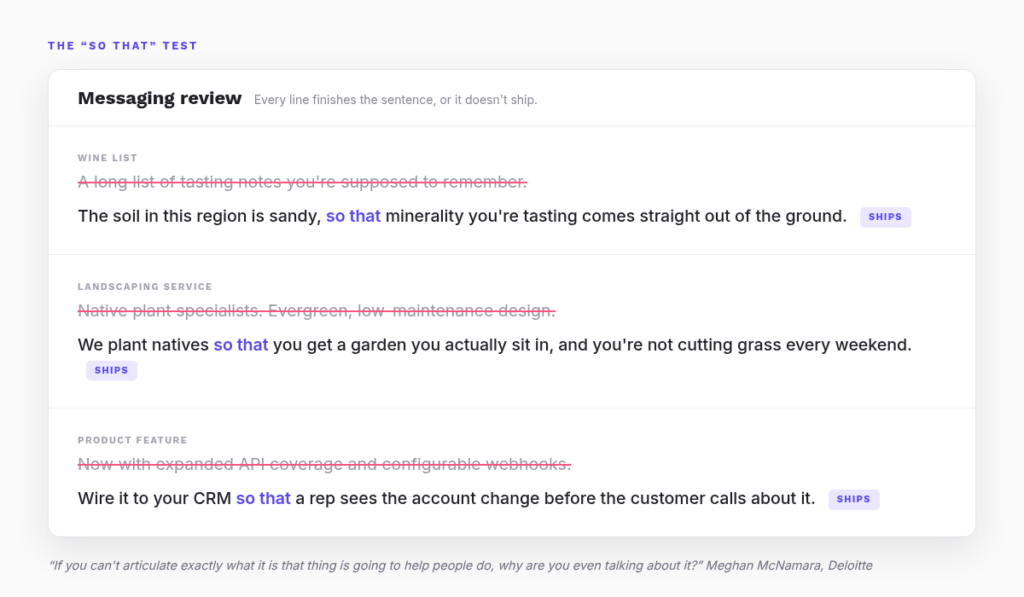
Fluff isn’t harmless. Your reader is keeping score.
Here’s the bit that should change how you edit. Nora’s audiences are so short on time that fluff doesn’t just get skimmed. It gets read as evidence, and the verdict isn’t kind.
“When the reader can sense the fluff they lose that trust. It’s almost like they’re signaling, well, you don’t trust me well enough to just be straightforward with me, and now I just want to delete this email.”
Nora Ioane, SpecialtyCare
A busy clinician isn’t going to conduct a careful audit of your credibility. In Nora’s words, “they don’t have time to kind of sift through and decide if you’re trustworthy or not,” so you may as well “lead with copy that is trustworthy and save them some time and save yourself some time.”
The habit she had to break was over-explaining, and she’s honest about where it came from. As a high school English teacher, she noticed that over-explaining “made them feel like I didn’t trust them to be smart enough to receive a base level explanation.” In her own writing, she traced the same impulse back to insecurity. Her cure is memorably dramatic: “There needs to be some kind of ego death at play, to remind myself that not every single thought that I have is worthy of being put out into the open.” Every marketer with a 1,400-word email in their drafts folder just felt that one.
Meghan describes the AI-era version of the same problem. She uses AI constantly, as a thought partner and to pressure-test her own business cases. But she still does the slow qualitative work herself: buyer interviews, subject matter expert conversations, the lot. Her reason is precise:
“If you are close enough to the research, you’re going to be able to find those hallucinations. If you are not, it’s going to be very difficult to spot them.”
Meghan McNamara, Deloitte
She calls what develops from doing the work yourself “earned intuition,” and she’s clear that “not everything should be made efficient by the use of AI.” The payoff shows up in the room, when she can say with a straight face: “I did that work. I know that.”
Padding and hallucinations look different on the page. To a buyer, they send the same message: the writer didn’t know enough to be brief.
Meghan’s full conversation, including the “so that” test and how she uses AI to challenge her own assumptions instead of writing for her, is worth an hour of your commute.
Show your draft to someone who thinks nothing like you
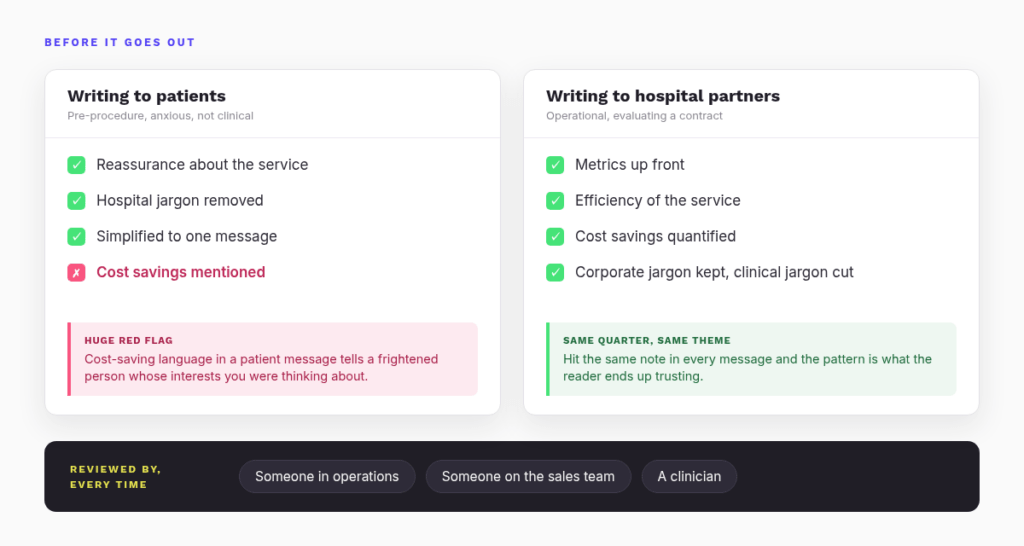
Nora’s most portable habit costs almost nothing and catches the mistakes that damage trust fastest. Before a message goes out, she runs it past a small standing group of reviewers, chosen specifically because they think differently: someone from operations, someone from sales, and a clinician.
“Those messages will land differently to all of those eyes,” she says. A sentence that seems perfectly fine to a communications pro can be quietly wrong to someone who works in a hospital every day, “and it actually might cause more damage.” She’s upfront about why she needs them. She brings the writing background, not the clinical one, so she brings in people who have it and makes sure “this is not a tone deaf message that we’re sending out.”
She also keeps a short checklist for each audience, which works like a second reviewer that never takes a day off:
- Patients get reassurance and plain language.
- Hospital partners get metrics, efficiency, and cost savings.
- Cost-saving language in a patient message is a “huge red flag,” because it tells a frightened person exactly whose interests you were thinking about.
Jan applies the same principle across an entire organization, and he calls it enrolling. Marketing may own the loudest channels, but “everyone has a role” in whether the brand gets believed. A banker in a branch is delivering the brand experience whether they think of it that way or not. That’s how the promise stays connected to the delivery: “with every experience, you understand that when M&T says something, they do it, and so slowly that trust is built.”
Trust runs on a slow clock. Stop checking it every five minutes.
This is the part that gets marketers into trouble with their own leadership, and Jan has the clearest way of explaining it.
“Trust doesn’t just happen, you earn trust, we all know that,” he says. The problem is that most organizations measure brand work on a performance-marketing stopwatch. His analogy: decide to get fit, train nonstop for 24 hours, then check the data. “The data available to you will give you the wrong information, will lead you to the wrong conclusion.” Train two hours a day for six months, though, and the proof is staring back at you in the mirror.
Nothing was wrong with the workout or the measurement. The window was wrong. Jan argues brand investment needs at least three years, and ideally five to ten, before the numbers mean much. Getting through that stretch requires “some level of belief that working out works to get you through those six months.”
Nora sees the same effect inside a single quarter. Her per-audience checklist isn’t just a quality gate. It’s a consistency engine.
“You can never give somebody information once and expect them to master it based off of that one interaction.”
Nora Ioane, SpecialtyCare
Hit reassurance in every patient message, and when you look back at the quarter, “you see a theme of reassurance.” That theme is stronger than any single message could ever be on its own.
Jan and Nora are describing one mechanism at two zoom levels. Trust isn’t built by a message. It’s built by the pattern a hundred messages make. That’s exactly why it can’t be rushed, and exactly why inconsistency is so expensive.

Your Monday homework (spoiler: it’s mostly deleting)
Pull up the last five things your team published and ask two questions of each one:
- Did we claim something about ourselves that a customer could have said instead?
- Did we name the consequence, or stop at the capability?
You’ll find at least one you can fix this week. And the fix is usually taking something out, not adding something in. Your readers will thank you, mostly by actually finishing the thing.
Want the full conversations? They’re well worth your time:
- Meghan McNamara on storytelling and the “so that” test
- Jan Liebchen on why trust drives long-term growth
- Nora Ioane on what teaching taught her about trust and attention
One honest warning about consistency
It’s brutally hard to hold across a team. The moment three people start making content, your lovely reassurance theme begins to drift, and drift is exactly what buyers notice.
That’s the problem we built Lumen5 to solve. Your brand kit, fonts, colours, and templates all live in one place, so every video your team makes looks like it came from the same company, whether it was made by your designer or by the product marketer who’s never opened an editing timeline in their life. And because Lumen5 turns the articles, transcripts, and documents you already have into on-brand video, your team spends its energy on the message instead of the mechanics.
If your team is trying to sound like one voice across a lot of content, we’d love to show you how. Take a look at what Lumen5 can do for you, or book a demo and we’ll walk you through it.
And if you want more conversations like these, from marketers who’ve actually done the work, listen to the Supercharge Marketing podcast wherever you get your podcasts.
Frequently asked questions
How do B2B buyers decide to trust a vendor when they can’t evaluate the product?
When buyers can’t test a product before committing, they judge the signals around it: customer stories, how clearly the vendor explains next steps, how well sales answers follow-up questions, and how consistent the messaging is. On the Supercharge Marketing podcast, M&T Bank’s Jan Liebchen explains that having existing customers vouch for you is far more persuasive than claiming trustworthiness yourself.
What is the “so that” test in product marketing?
The “so that” test is a messaging check shared by Meghan McNamara, who leads product marketing and go-to-market for Deloitte’s Government and Public Services practice. Every description of a product capability has to finish with “so that,” followed by what the customer can do and the benefit they’ll get. If you can’t complete the sentence, the capability probably shouldn’t be in the message.
Why does jargon and fluff hurt trust in B2B marketing?
Jargon can make readers feel like they’re being misled, and padding signals that the writer doesn’t trust the reader or doesn’t know the subject well enough to be brief. SpecialtyCare’s Nora Ioane notes that time-poor audiences like clinicians won’t sift through fluff to decide if you’re credible. They’ll simply stop reading.
How long does brand investment take to show results?
According to Jan Liebchen of M&T Bank, brand investment needs at least three years, and ideally five to ten, before the results show up reliably in the data. Measuring brand work on a short performance-marketing timeline can lead teams to the wrong conclusions.
How can marketing teams keep messaging consistent across many people and channels?
Practical approaches include per-audience messaging checklists, a standing group of reviewers from different functions, and shared brand assets. Lumen5 helps teams keep video content consistent by storing brand kits, fonts, colours, and templates in one place, so anyone on the team can produce on-brand video without specialist editing skills.
Lumen5 helps B2B marketing teams produce more video content faster and at a fraction of traditional production cost. Learn more or book a demo →