

Marketing Strategy | Video Marketing
Somewhere in a very large company right now, a marketer is looking at an agency quote for a two-minute video and quietly calculating how many coffees that money could buy. (All of them. Everyone gets coffee. Forever.)
Down the hall, three people are trying to produce video for an entire global sales team. Upstairs, the CEO has just asked for “a quick video” about the new strategy, which everyone knows is neither quick nor one video. And somewhere in IT, a security analyst has just discovered that dozens of employees have been signing up for video tools with their work email like it’s a free sample stand at the supermarket.
None of these people are doing anything wrong. They’re all running into the same wall. And we know that, because we’ve heard about that wall from the people standing in front of it, a lot.
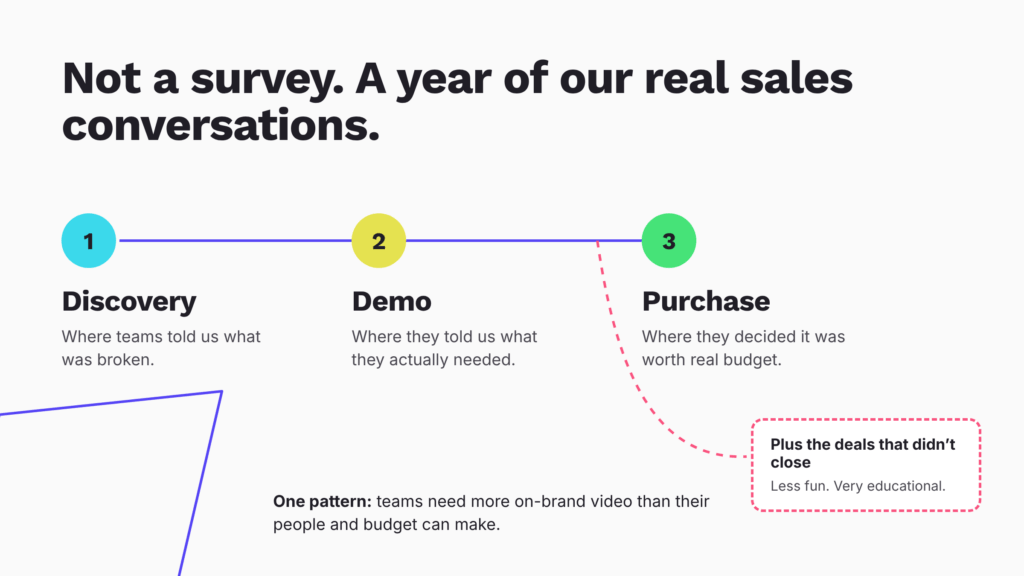
This isn’t a survey. It’s a year of our real sales conversations.
Most “why companies buy X” articles are built on a survey of 200 people who clicked a link for a gift card. This one isn’t. 🥸
Over the past year, we went back through every enterprise sales conversation we had at Lumen5, following real teams through the whole journey: the first discovery call, where they explain what’s broken; the demo, where they tell us what they actually need; and the purchase, where they decide it’s worth the budget. We also went through the deals that didn’t close (less fun, very educational), because “why not” teaches you nearly as much as “why yes.”
Then we did what any self-respecting marketing team would do. We put it all in a spreadsheet and looked for patterns until our eyes hurt. 😢 But we did it for you.
What came out wasn’t a theory. It’s what real marketing, communications, and brand teams at large organisations told us, in their own words, while deciding whether to spend real money. One sentence explained almost all of it:
Enterprise teams spread video production in-house to multiple content teams because they can’t make enough on-brand video with the people and budget they have.
But “in-house” turned out to be only half the story. The teams that got the most out of the move didn’t just shift video from an agency to an internal video team. They opened video creation up to everyone who creates content: marketers, comms leads, regional teams, trainers, even support. Video stopped being something one specialist makes and became something any content creator can make, with the brand built in.
The ten reasons below are the different ways that one sentence shows up at work, shared by executive sponsors, day to day owners, brand gatekeepers, and content reviewers. And here’s the twist: it almost never shows up alone. Most teams we spoke with were dealing with two or three of these at once, usually while pretending everything’s fine in the quarterly review.
The short answer: the three reasons we hear most 📣
If you only have the attention span of a scrolling thumb (no judgement, so do we), here’s the summary. Across a year of our discovery calls, demos, and purchase decisions, the three most common reasons enterprise teams bring video in-house are:
- Agency costs are too high for the volume of video the business now expects.
- A small team can’t keep up with demand from sales, regions, and business units.
- Brand control falls apart once lots of people start making video on their own.
The fix teams kept landing on: put video creation in the hands of the people who already create content, inside guardrails that keep every video on-brand.
Now for the full ten, ranked roughly by how often we heard them on real calls.
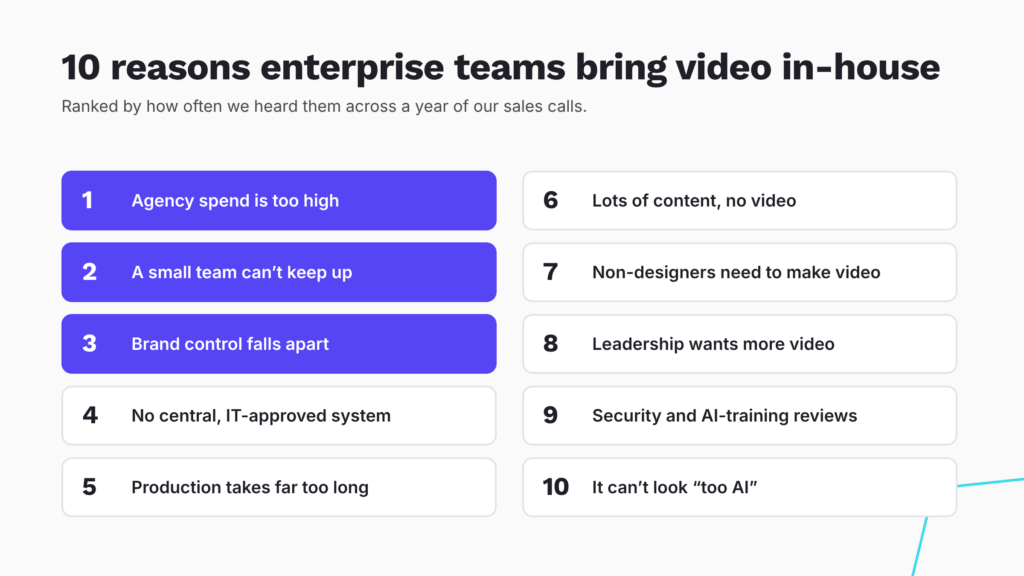
1. The agency invoice that made everyone go very quiet
Agencies make beautiful things. That’s not the problem. The problem is the maths.
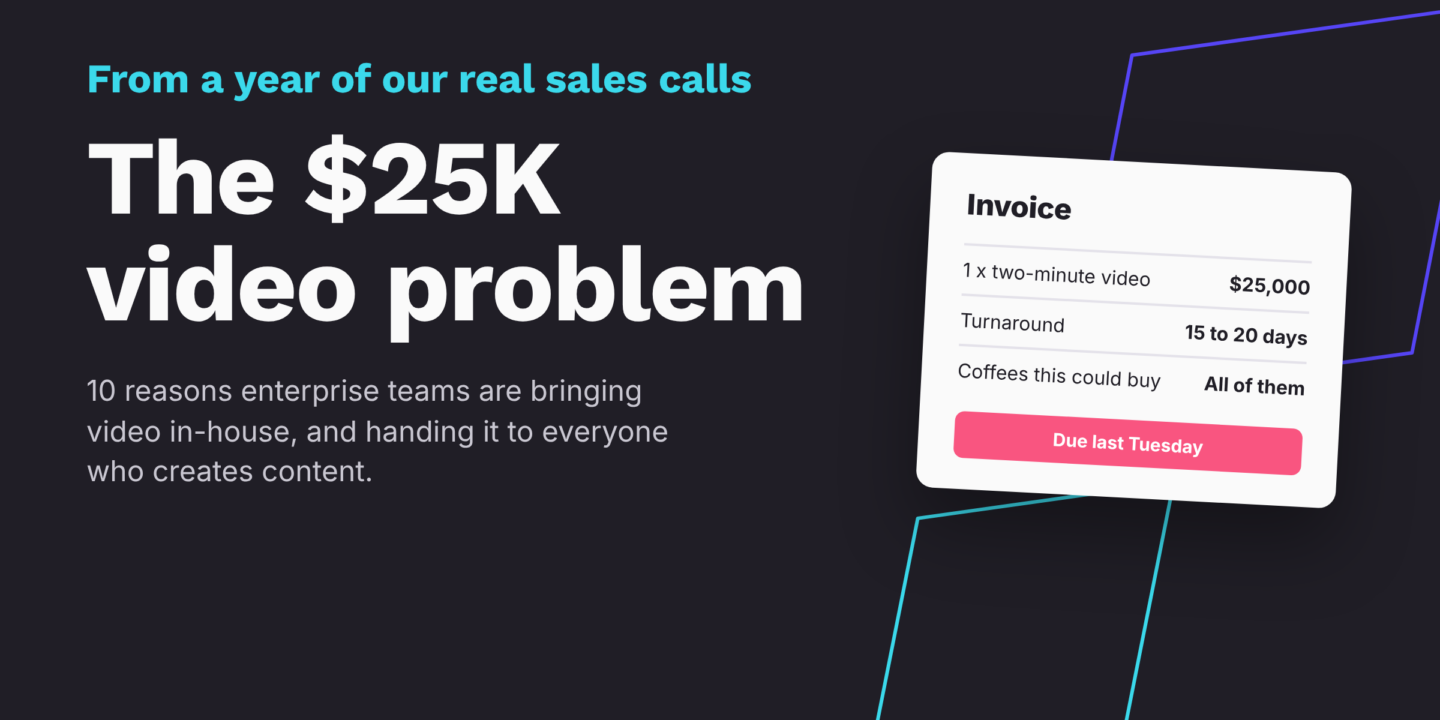
One marketing leader summed it up for us without blinking: “Agency work can cost upwards of $25K per video.” Add a turnaround of 15 to 20 days, and you’ve got a process built for a flagship brand film being used for a product update that needed to go out last Tuesday.
That’s the mismatch we see over and over. Teams aren’t firing their agencies in a dramatic boardroom scene. They’re keeping agencies for the big, once-a-year moments and bringing everyday video in-house, because paying five figures for a 45-second explainer starts to feel less like an investment and more like a hobby.
The signal: your agency bill is growing faster than your video library.
2. Three marketers, one hundred sales reps, zero chance
If you want to see a marketing team’s soul leave its body, ask them how many people they support.
One team we spoke with had three marketers supporting 17 business units and 124 sales reps. Another had a single video producer, who was (understandably) tired. Another discovered that exactly two people in the entire organisation knew how to edit video, which is less a team and more a hostage situation.
Every request goes into the same queue. The queue gets longer. Sales starts making their own videos on their phones. Which brings us neatly to reason three.
The signal: “Can you just make a quick video?” is the most common message in your inbox, and none of them are quick.
3. When the brand lead becomes the brand police
Here’s what happens when video demand outgrows a small team: everyone else starts making it. Regional teams, product teams, the very enthusiastic person in sales who just discovered transitions. The volume problem gets solved, and a brand problem appears in its place.
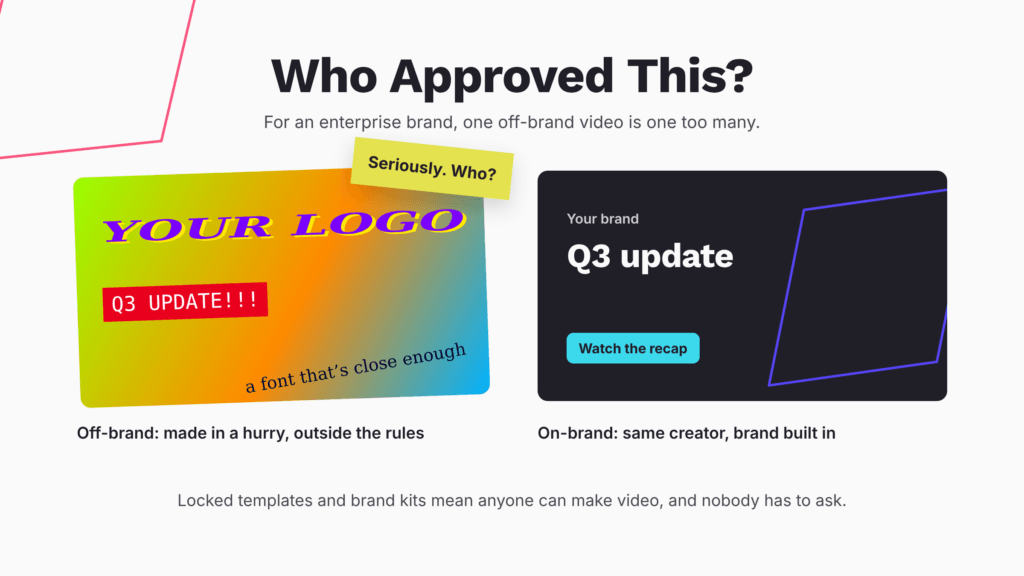
Every brand lead knows the moment. A video goes live on a regional channel. The logo is stretched. The font is “close enough.” There’s a colour in there that legally shouldn’t exist. And then someone, somewhere, types the three words that ruin a perfectly good afternoon: “Who Approved This?”
For a small company, an off-brand video is a bit embarrassing. For an enterprise, it’s a real no-go. A global brand is built on thousands of people showing up the same way, every time, in every market. One rogue video can undo years of careful brand work, and it can do it in front of customers, investors, and regulators.
One brand lead described their goal perfectly. They wanted to “let go of control over production without losing control over brand.” Another team told us their brand lead had become, in their words, the “brand police,” which is a job nobody applies for and everybody hates doing.
The answer isn’t to stop people making video. It’s to give them guardrails they can’t accidentally drive through: locked brand templates, approved fonts and colours, logos that sit where they’re supposed to. When the brand is built into the tool, the brand lead gets to go back to building the brand instead of writing very polite emails about off-brand thumbnails.
The signal: you’ve said “Who Approved This?” out loud at least once this quarter. (Twice if you count muttering.)
4. The secret video empire nobody approved
This one surprises leadership every single time.
One global organisation we worked with found nearly a hundred separate accounts on our platform tied to their company domain. About a dozen were paid for. None were governed. Nobody had planned it. People had a job to do, found a tool that helped, and got on with it.
That’s actually a great sign. It means the demand is real and the people closest to the work have already voted with their email addresses. But it also means scattered billing, no shared brand assets, and an IT team that would like a word.
So teams move from a patchwork of self-serve seats to one central, IT-approved system where everyone works from the same brand kit, under the same security setup, on the same invoice.
The signal: search your company domain in your favourite video tool’s admin panel. Brace yourself.
5. Production timelines measured in seasons
Some teams don’t have a cost problem or a headcount problem. They have a calendar problem.
We’ve heard from teams spending two to three months producing a single video in professional desktop editing software, and others with roughly a one-month turnaround on videos for press announcements. By the time a news video is ready, the news has become history, and arguably the video now belongs in a museum.
Professional editing tools are brilliant at what they do. But when every video goes through the most powerful (and slowest) process available, you end up using a precision instrument to butter toast.
The signal: your video project plans have the word “quarter” in them.
6. Sitting on a pile of content nobody turned into video
This is the reason we find the most fun, because the content already exists. It’s just stuck.
Press releases, blog posts, webinar recordings, research reports, PDFs that took weeks to design. Teams describe themselves as “very content rich” and, in the same breath, slow to publish. The ideas are there. The research is done. The approvals have happened. It just hasn’t become the format people actually watch on their feeds.
We wrote a whole piece on this problem, Stop Making More Content. Start Using the Content You Already Made., and the short version is this: turning existing written content into video is one of the fastest ways to get more out of work you’ve already paid for. It’s also, not coincidentally, exactly what Lumen5 was built to do.
The signal: your shared drive has more finished content than your social calendar has slots.
7. Non-designers need to make video too (and they’d like it to look good)
Video isn’t just a marketing job anymore. We’re seeing it requested by customer support teams, proposal teams, internal training teams, and corporate communications. The people in those roles are experts in their field. They are not, and do not want to become, motion designers.
Teams told us that general-purpose design and editing apps were too hard for non-video staff to pick up and use well. A recurring wish we heard: replace slide decks with short videos. Which, honestly, is a gift to every employee who has ever sat through slide 47 of a 60-slide training deck.
When the tool is easy enough for a non-designer and the brand template does the design thinking for them, the person with the knowledge can make the video. No queue, no brief, no back-and-forth.
The signal: your training team is still emailing PDFs and wondering why nobody reads them.
8. The CEO asked for one video
Never underestimate the power of a single executive request.
In one company, the CEO asked for one video. It turned into an organisation-wide mandate for video. This happens more often than you’d think. A new VP arrives with a push for innovation. Leadership asks every team to explore AI tools. Suddenly “we should do more video” goes from a nice idea to a line in everyone’s goals.
The team on the receiving end of that mandate needs a way to deliver at volume, fast, without hiring a production studio. That’s usually the moment they start looking.
The signal: someone senior has used the phrase “video-first” in a town hall.
9. Security review: where enthusiasm goes to wait
Here’s the reason nobody puts on a marketing slide, but everyone in a regulated industry knows by heart.
Teams in finance, healthcare, and pharmaceuticals need enterprise security as a starting requirement, not a nice extra. That means single sign-on (SSO), formal Responsible AI reviews, and the ability to opt out of having their content used for AI training. In the larger organisations we work with, legal and security reviews often took one to four months to complete.
That’s not a bad thing. Those reviews exist for very good reasons. But it does mean the “fun” video tool someone found online often never makes it past procurement, while a platform built with enterprise requirements in mind can. If you’re in a regulated industry, check the security and AI-training policies first. It’ll save you from falling in love with a tool your InfoSec team will never approve.
The signal: your legal team has a folder called “AI tools: pending.”
10. It has to look like real video, not a robot in a blazer
The last reason is the one that tells you the most about where the market is heading.
AI-generated avatars and fully generated video have their uses. But several enterprise teams told us they passed on avatar-based tools because the output felt, in one team’s words, “too AI.” Another team compared us with a generative video model from one of the world’s biggest tech companies and chose Lumen5 for two very human reasons: a custom branded template and a dedicated customer success manager.
When your audience is customers, investors, or your own employees, the video has to feel like it came from your company. Not from a digital spokesperson with suspiciously perfect posture.
The signal: someone on your team watched an AI avatar demo and said “hmm” in that particular tone.
What all ten reasons have in common
After a full year of discovery calls, demos, and purchase decisions, the pattern is hard to miss. Every reason on this list comes back to that one sentence: more video is expected than the current people, budget, or process can produce, and the brand has to survive the journey.
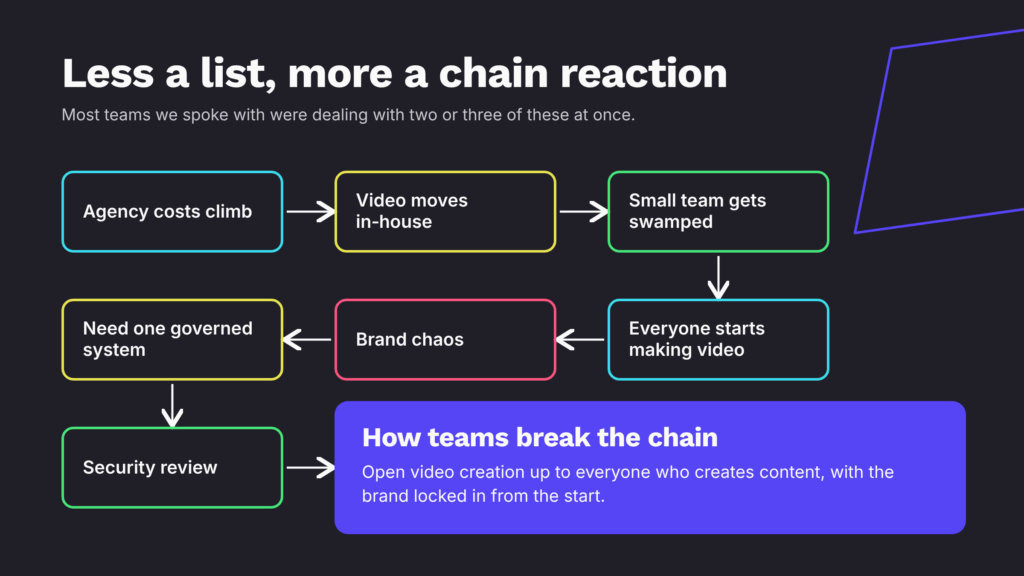
That’s why it’s rarely one reason in isolation. Agency costs push teams in-house. In-house means a small team. A small team means other people start making video. Other people making video means brand chaos. Brand chaos means a governed system. A governed system means a security review. It’s less a list and more a chain reaction.
The teams that handle this well don’t try to fix all ten at once. They pick the reason that hurts most and solve for it in a way that doesn’t create the next one. And the approach that breaks the chain is the same every time: give everyone who creates content the ability to make video, with the brand locked in from the start. No more calls from your CMO asking “Who approved this?!”
How Lumen5 helps teams solve all ten
Here’s the part we’re genuinely proud of. Every reason on this list came from a real customer conversation, and every one of them is a problem we’ve helped customers solve. Not by adding another production queue, but by opening video creation up to the people who already create content, with the brand protected at every step.
- Agency costs and slow timelines (reasons 1 and 5): everyday video moves in-house and gets made in minutes or hours instead of weeks or months. Agencies can stay on the big, once-a-year moments.
- Small teams and mounting demand (reasons 2 and 8): instead of one stretched video producer serving everyone, marketers, comms teams, regional teams, and trainers make their own videos. The central team goes from bottleneck to brand steward.
- Brand chaos (reason 3): brand kits and locked templates keep colours, fonts, and logos where they belong, whoever is making the video. Fewer “Who Approved This?” moments. Ideally none.
- Scattered accounts (reason 4): one central, IT-approved workspace replaces the patchwork of unofficial accounts, with everyone working from the same brand assets.
- Unused content (reason 6): the blogs, press releases, reports, and webinar recordings teams already have become video, without starting from a blank timeline.
- Non-designers (reason 7): people who’ve never opened an editing app can make polished, on-brand video, because the Lumen5 template does the design thinking for them.
- Security and AI reviews (reason 9): enterprise security and AI-training opt-out are built for the reviews regulated teams have to pass.
- “Too AI” output (reason 10): the result looks like real, branded video from your company, backed by a dedicated customer success manager, not a digital spokesperson.
How to tell if your team is about to hit this wall
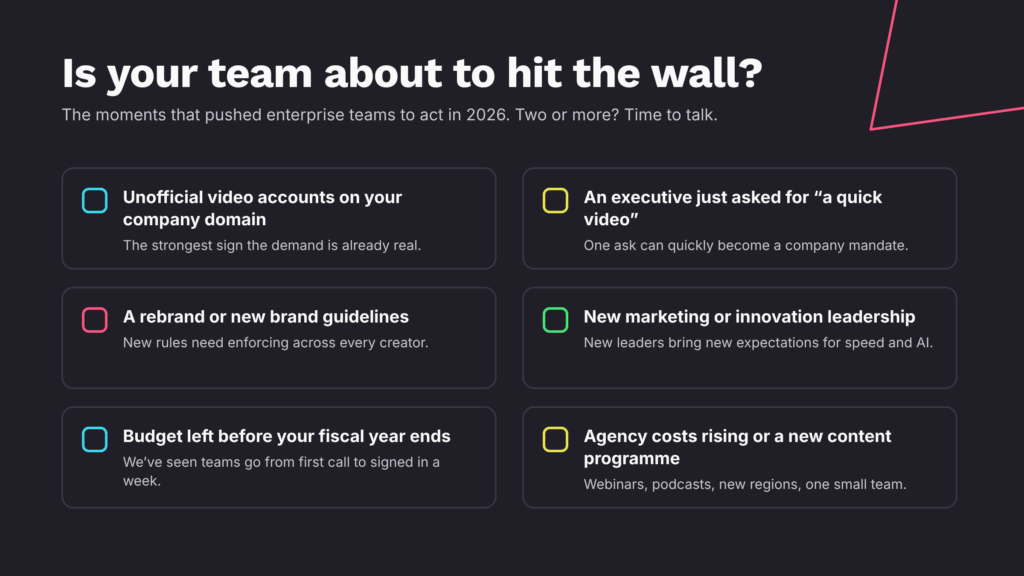
Based on what we saw across 2026, these are the moments that most often push an enterprise team to bring video in-house. If two or more sound familiar, it might be time to have the conversation.
- People are already using video tools without a governed setup. Unofficial accounts on your company domain are the strongest sign that demand is real.
- An executive has asked for video. One request can turn into a company-wide expectation very quickly.
- You’re launching a rebrand or new brand guidelines. New guidelines need enforcing across everyone who creates content, not just the design team.
- There’s new marketing or innovation leadership. New leaders often bring new expectations for speed, volume, and AI.
- You have budget left before your fiscal year ends. We’ve seen teams move from first conversation to signed agreement in about a week when timing lines up.
- Your agency costs are rising, or a new content programme is starting. Think webinar series, podcasts, regional expansion, or more business units sharing one small team.
Who’s usually involved in the decision
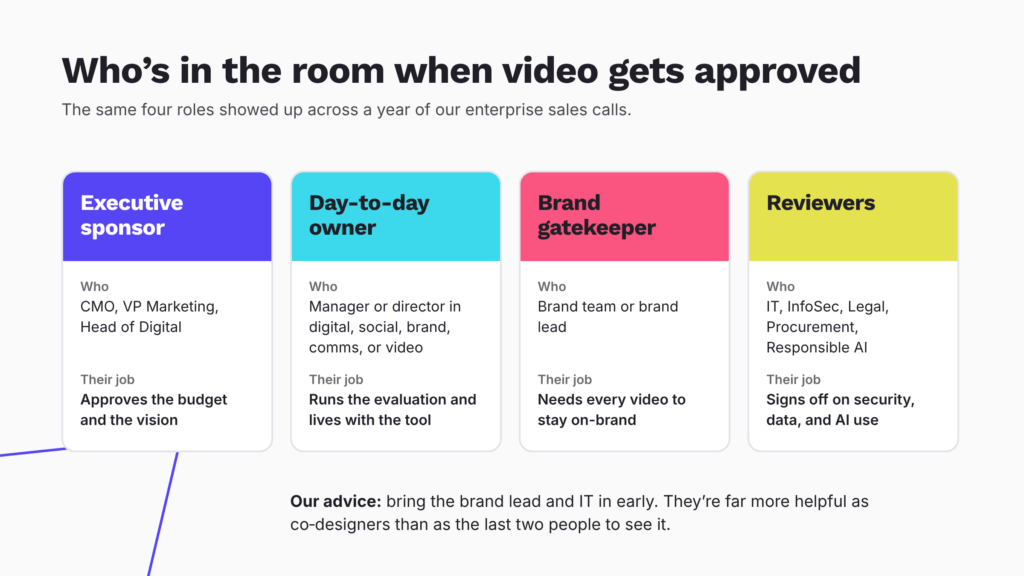
If you’re the person trying to get a video platform approved inside a large organisation, it helps to know who’s in the room. Across the enterprise teams we worked with in 2026, the same roles kept appearing:
- The executive sponsor (CMO, VP of Marketing, Head of Digital) approves the budget and the vision.
- The day-to-day owner (a manager or director in digital marketing, social, brand and design, corporate comms, or video strategy) runs the evaluation and lives with the tool afterwards.
- The brand gatekeeper (the brand team or brand lead) needs to know the output will stay on-brand.
- IT, InfoSec, Legal, Procurement, and Responsible AI reviewers need to sign off on security, data handling, and AI use.
Our advice: bring the brand lead and IT in early. They’re far more helpful as co-designers of the rollout than as the last two people to see it.
Frequently asked questions
Why are enterprise companies bringing video production in-house? Based on a year of Lumen5’s enterprise sales conversations, from discovery through demo to purchase, most enterprise teams bring video in-house because demand for video has outgrown their budget and headcount. The most common triggers are high agency costs (often upwards of $25K per video with 15 to 20 day turnarounds), small teams that can’t keep up with requests from sales and business units, and a need to keep brand control as more employees create video.
How do large companies keep video on-brand when many people are creating it? They use a central video platform like Lumen5 with locked brand templates and brand kits that control colours, fonts, and logos. This lets non-designers create video without the brand team reviewing every single piece by hand, so everyone from your Sr Creative Director to your day 1 marketing intern can create an on-brand video.
What security requirements do enterprise teams look for in a video creation tool? Teams in regulated industries like finance, healthcare, and pharmaceuticals typically require single sign-on (SSO), approval through a Responsible AI review, and the ability to opt out of having their content used for AI training. Legal and security reviews can take one to four months.
Is AI avatar video a good fit for enterprise marketing? It depends on the audience. Several enterprise teams we spoke with in 2026 chose branded, template-based video over avatar tools because avatar output felt “too AI” for customer-facing and internal communications.
What does it mean to open up video creation to everyone in an enterprise? It means video is no longer made only by a specialist video team or an agency. Instead, anyone who creates content (marketers, communications teams, regional teams, trainers, and support staff) can make video themselves, using a platform with locked brand templates so every video stays on-brand. Lumen5 helps enterprise teams do this so they can produce more video without adding headcount or risking off-brand content.
How can enterprise brands avoid off-brand video? By building the brand into the tool rather than relying on manual review. Brand kits, locked templates, and a single governed workspace mean every video starts on-brand, so brand teams spend less time policing and more time building the brand.
What content can be turned into video? Almost anything text-based: blog posts, press releases, webinar recordings, research reports, PDFs, and slide decks. Turning existing content into video is one of the fastest ways for content-rich teams to publish more without producing more from scratch.
The bottom line
If you recognised your team in three or more of these reasons, you’re not behind. You’re just normal. Every large organisation we spoke with across a full year of sales conversations was doing the same balancing act: more video, same people, same budget, and a brand that has to come out the other side looking like itself.
The good news is that you don’t need a bigger team or a bigger agency budget to fix it. You need a way for everyone who already creates content to turn the content you already made into video that already looks like your brand. That’s what we help our enterprise customers do, and honestly, it’s our favourite part of the job.
Because the goal was never just “more video.” It’s more video that nobody has to ask “Who Approved This?” about.
See how Lumen5 helps enterprise teams make on-brand video at scale →
And if you’d like to hear how marketing leaders are tackling these challenges in their own words, tune in to the Supercharge Marketing podcast. Fun fact: at least one enterprise team restarted their conversation with us after hearing an episode. We’re choosing to take that as proof that podcasts work.
Listen to Supercharge Marketing on Apple Podcasts →
Lumen5 helps B2B marketing teams produce more video content faster and at a fraction of traditional production cost. Learn more or book a demo →