

Marketing Strategy | Podcast
You know the meeting. Someone pulls up the quarterly numbers, and the deals that closed have your team’s fingerprints all over them. You just can’t prove it in a way anyone will accept.
The webinar that started one of those conversations ran fourteen months ago. The technical guide the buying committee passed around like a family recipe never had a form on it, so there’s no record of who read it. And the campaign you’re proudest of, the one that changed how three big accounts talk about the problem you solve, sits in a column that confidently says zero.
So you do what everyone does. You report the number you can defend instead of the number that’s true. Lead volume looks healthy. Cost per lead is down. Heads nod, the budget lives to see another quarter, and you walk out knowing you just presented the least important thing your team did all year.
Meanwhile, sales has quietly stopped reading your reports. They’ve met too many “qualified leads” who turned out to be students, competitors, or someone who really, really wanted that PDF.
Key takeaways
If you only have 30 seconds before your next meeting, here’s the short version:
- The average B2B buying journey now runs 272 days, so a 90-day attribution window misses most of marketing’s real work.
- Count accounts, not people. ABB replaced MQLs with marketing qualified accounts (MQAs) and blocked personal emails on forms, improving lead quality by 33%.
- Efficiency isn’t impact. Report a three-link chain with real numbers: “We did X, it led to Y, and the outcome is Z.”
- Don’t try to win the attribution argument. Qualcomm’s marketing ops team stopped fighting over credit and focused on owning the data instead.
- Show who let leads go cold. A shared follow-up dashboard turns marketing versus sales into marketing plus sales.
- Clean your data before you point AI at it. Messy records don’t get smarter with a model. They just get messier, faster.
Why is it so hard to prove marketing’s impact in long B2B sales cycles?
Spoiler: it’s not because your team is bad at reporting. It’s arithmetic, and the arithmetic keeps getting worse.
Dreamdata’s 2026 LinkedIn Ads B2B Benchmarks Report, built on 66 million sessions across 3.5 million customer journeys, puts the average B2B buying journey at 272 days. A year earlier, it was 211. Buyers now spend roughly the first 220 of those days educating themselves before they go anywhere near a sales pipeline, and 81% of the journey happens outside the pipeline entirely. The number of stakeholders involved has climbed to ten, up from under seven.
Now hold that up against a 90-day attribution window. Most of your best work quietly expires before your reporting even notices it existed. It’s like judging a slow cooker after twenty minutes and declaring it broken.
This exact problem kept popping up across three recent conversations on the Supercharge Marketing podcast, each from a different angle:
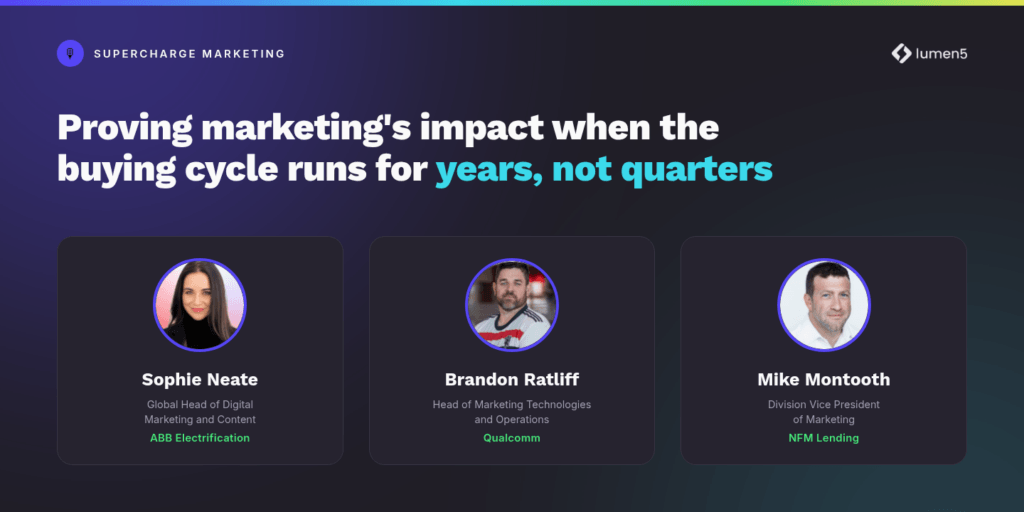
- Sophie Neate, Global Head of Digital Marketing and Content at ABB Electrification, runs campaigns across more than 100 countries, where a single deal can take a year or more to close.
- Brandon Ratliff, Head of Marketing Technologies and Operations at Qualcomm, spent a full year wrestling with attribution before deciding to stop wrestling.
- Mike Montooth, Division Vice President of Marketing at NFM Lending, has spent two decades learning how to describe marketing’s results in language a finance team actually trusts.
Here’s what they’d change.
Stop counting leads. Start counting accounts that can actually buy.
Sophie’s team made a change that sounds small and absolutely isn’t: they retired the marketing qualified lead.
At ABB, marketing now reports on opportunities, won deals, and influence, all tracked at the account level instead of the person level.
“We have evolved from MQLs to MQAs.” Sophie Neate, ABB Electrification
That’s marketing qualified accounts, which then move through to sales qualified accounts. The logic is hard to argue with. When ten people from one company circle a purchase for a year, counting them as ten separate leads tells you nothing useful. Counting them as one account with rising engagement tells you nearly everything.
Then ABB did something that would make most demand gen teams break into a cold sweat. They removed the option to use a personal email address on contact forms. No Gmail, no Hotmail, work addresses only.
Yes, that shrank the top of the funnel on purpose. It also exposed something they hadn’t fully accounted for: “we often find that competitors, our competitors are doing that,” Sophie says. Turns out some of those enthusiastic downloads were coming from the people you’d least like to hand your playbook to.
The payoff was a 33% improvement in lead quality. And Sophie is refreshingly honest that it didn’t feel like a sure thing at the time.
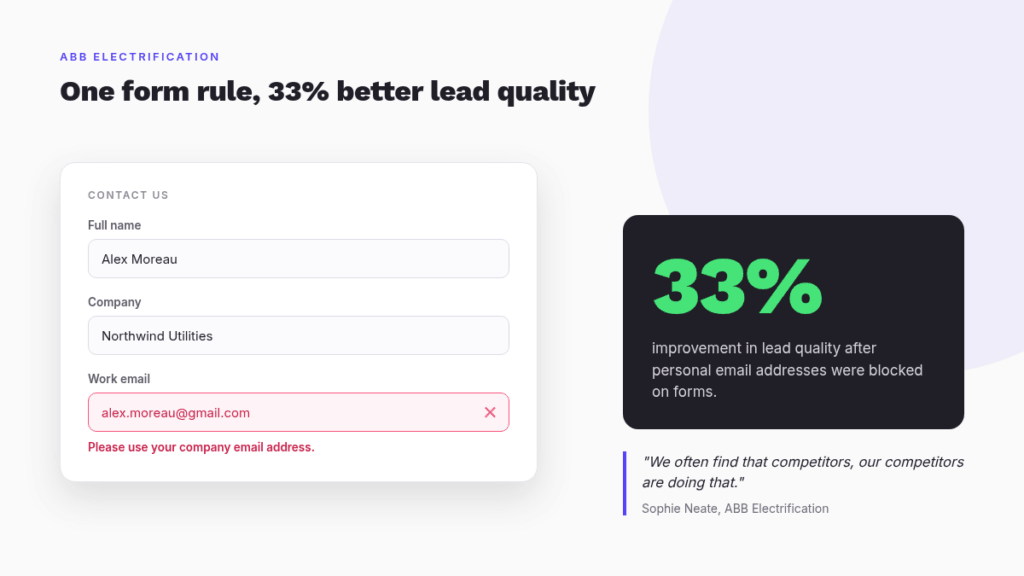
“Making that bold decision, and it was a nerve-wracking decision to make, has improved our lead quality by 33%.” Sophie Neate, ABB Electrification
That’s the trade worth sitting with. You give up a number that looked good in a slide and gain one you can stand behind for the twelve months it takes the deal to land.
Listen to Sophie’s episode: Defrictioning the Buyer’s Journey with Sophie Neate > https://podcasts.apple.com/us/podcast/defrictioning-the-buyers-journey-with-sophie-neate/id1597823763?i=1000766278976
Efficiency isn’t impact (and your CFO can tell the difference)
Mike names the mistake precisely, and he’s generous enough to name it as his own. Early in a career, he says, marketers fall into a pattern:
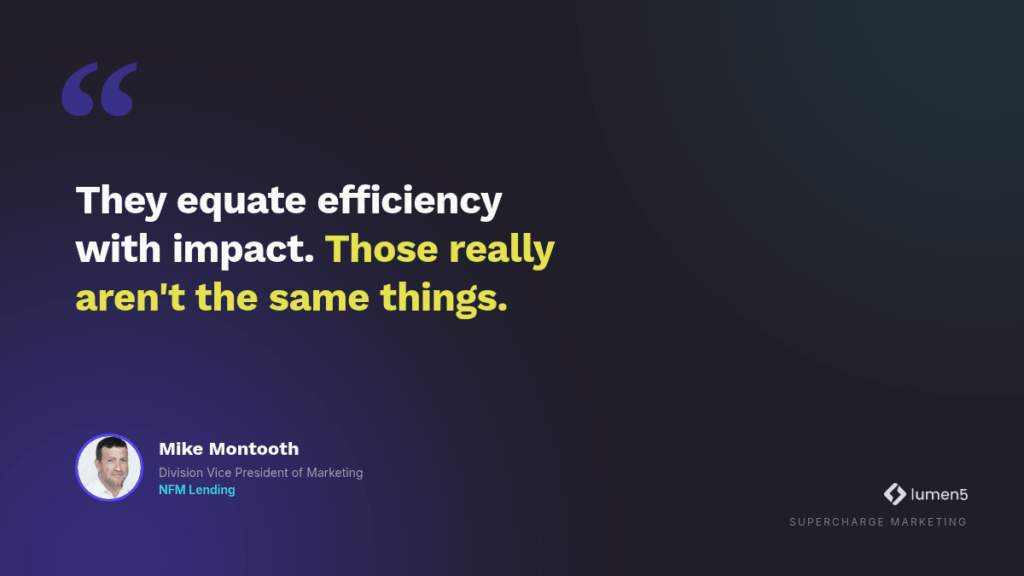
“They become a task taker, they just get the task done. They don’t really think about the business need, why am I doing this? They equate efficiency with impact. Those really aren’t the same things.” Mike Montooth, NFM Lending
In a long sales cycle, that distinction matters more than almost anything else, because efficiency metrics are the ones that report fast. Cost per lead updates every week. Revenue influence shows up in nine months, if you’re lucky. So the fast number wins by default, and marketing ends up judged on how cheaply it produced things nobody can connect to a sale.
Mike’s fix is unglamorous and wonderfully specific. Build one sentence with three links, and put a real figure on every link:
“We’ve done X, it led to Y, and the outcome is Z.”
Advertising led to this many clicks, which led to this many leads, which led to this many sales, at $5 a lead or 10 cents a lead or whatever it really is. No adjectives, no vibes, just the chain.
He’s also clear about who this sentence is for.
“Leadership, whether it’s the CEO, the CFO, the COO, all they care about is data.” Mike Montooth, NFM Lending
Show them real numbers, Mike says, and “they will be on your side and they will cooperate with marketing to the end.” That’s a better outcome than surviving another budget review by the skin of your teeth.
Brandon adds the discipline that keeps this from spiralling. Long cycles tempt teams into measuring absolutely everything, and when everything is a priority, nothing is.
“You can’t give me 16 priority ones.” Brandon Ratliff, Qualcomm
Pick the handful of outcomes the business genuinely cares about this year. Everything else becomes an internal diagnostic you check on your own time and keep far away from the board deck.
Listen to Mike’s episode on marketing in regulated industries >
Give up on winning the attribution argument
Ask Brandon what went badly last year and he doesn’t reach for a campaign.
“The toughest one from the last year was marketing attribution. It’s really hard in B2B.” Brandon Ratliff, Qualcomm
What made it hard wasn’t the maths. It was the people. “It’s a funny science on how you do multi-touch, single touch, weighted, unweighted attribution,” he says. Put a room full of stakeholders in front of those options and the conversation quickly turns into “my stuff matters more than that person,” or all the credit belongs to sales, or all of it belongs to marketing.
He calls it “such a loaded, energized conversation to have.” After a year inside it, his team walked away.
Not away from measurement, though. Away from the credit fight.
“We will give you the data that we have, and then you can go and talk about attribution and mixed media modeling and come back to us when you’re ready to activate, because we still own the data, we still own the operations.” Brandon Ratliff, Qualcomm
Instead, his team doubled down on three things: execution, education, and evangelism. That means steady, repeated work across marketing operations: supporting events, webinars, nurture programmes, the CRM, lead scoring, intent modelling, and segmentation. Less debating, more doing.
Sophie’s approach looks like the opposite and ends up in exactly the same place. Attribution and influence are officially among her KPIs. The difference is what she attributes to. Because ABB measures accounts instead of individual touches, there’s far less to argue about. The account either progressed or it didn’t, and everyone can see the engagement that came before it moved.
Brandon abandoned the fight. Sophie designed it out of existence. Neither tried to build a model that hands out perfect credit, because neither believes one exists. (If you’ve found one, please call us. We have questions.)
Score the signal, then show who let it go cold
Here’s where long cycles quietly spring a leak. A buyer does something meaningful in month four, and nobody notices for six weeks. By then, they’ve moved on, or worse, moved on to a competitor.
Sophie’s team runs a points system with published thresholds. Downloading a brochure, to use her example, earns 50 points. Cross a threshold like 1,000, and the record converts from a marketing lead into a sales lead, which is sales’ cue to reach out.
It’s not fancy. It’s legible, and that matters more. Everyone on both teams can see exactly why an account changed status, which means fewer “where did this lead come from?” messages.
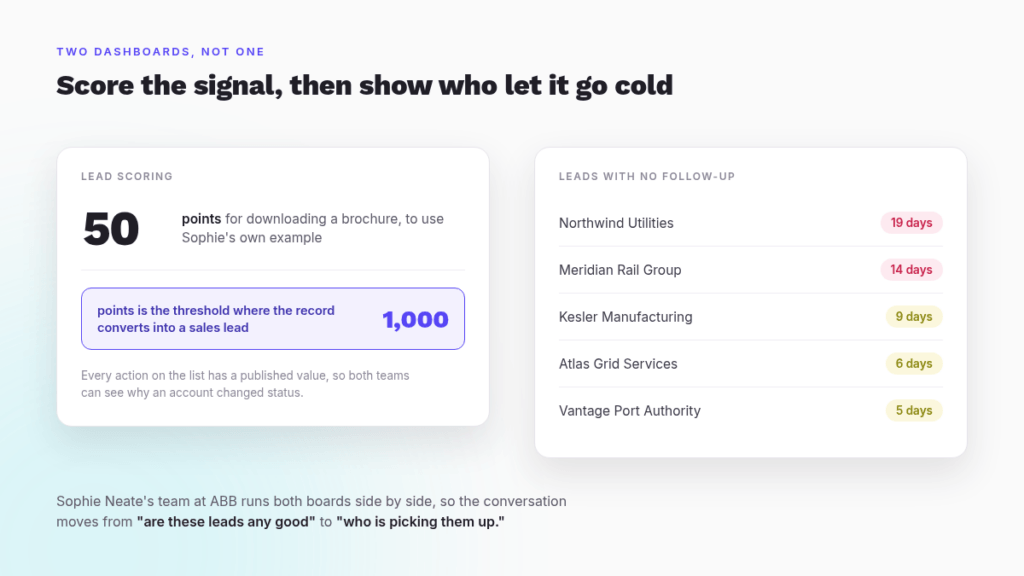
The part most teams skip is the second dashboard. Alongside the funnel view, ABB runs a Power BI board that shows which leads haven’t been followed up and how long they’ve been sitting there.
That one view flips the whole conversation. Instead of marketing defending lead quality, both teams look at the same list of accounts going cold. According to Sophie, sales now sees marketing as “an extended function of their team,” which is a long way from the days of “handing spam leads over.”
Mike arrives at the same tool from the other direction, and his advice is to treat it as an investment, not admin.
“Use the CRM. Use Power BI if you can. Use something where you can show leadership.” Mike Montooth, NFM Lending
He admits he learned this one late: “my gosh, I wish I had CRM, Salesforce and other things, 15, 20 years ago.” When your evidence has to survive a full year, the system that stores it is the evidence.
Clean the record before you point AI at it
Every measurement story now runs into the same tempting shortcut: just let AI figure it out. Brandon has watched that shortcut fail.
“If you have not done a good job stewarding your data from where it is to where it was to where it is today, you’re still gonna come up with the same sort of problems just on steroids, because garbage in, garbage out.” Brandon Ratliff, Qualcomm
He’s working with 27 million records. No model on earth can reconcile a year-long buying journey stitched together from inconsistent naming and mystery fields called “Campaign_Final_v3_REAL.”
His team’s safeguard is boring on purpose: common labelling, shared naming taxonomies, and a quick fix whenever something gets documented wrong. That boring foundation is what makes everything else possible. As Brandon puts it, “If we can manage it and I can measure it, then we’re off to the races already.”
Mike’s experience with generative AI tools matches. He uses them constantly for strategy drafts and content, and he’s clear-eyed about the limits. He’s had a tool “spit out a document and it’s completely wrong. It’s not set up the right way. I have to go in and do some manual work.”
AI is a useful first draft, not a finished answer. That goes double for your pipeline report.
What to change before your next quarterly review
You don’t need to rebuild your entire measurement model by Thursday. Pick one thing:
- If your reporting counts people, start counting accounts.
- If your quarterly deck leads with cost per lead, add Mike’s three-link sentence with real figures behind it.
- If your team is six months into an attribution debate, take Brandon’s exit: own the data, hand over the argument, and get back to work you can actually point at.
- If leads are going quiet between marketing and sales, build one shared view of who’s waiting and for how long.
Frequently asked questions
How do you measure marketing ROI when the B2B sales cycle is longer than a year? Shift from person-level metrics like MQLs to account-level metrics like marketing qualified accounts, opportunities, won deals, and influence. Then report a clear chain of cause and effect with real numbers at each step, such as spend to clicks to leads to sales.
What is a marketing qualified account (MQA)? An MQA is a target company showing enough combined engagement across its buying committee to be worth sales’ attention. ABB Electrification moved from MQLs to MQAs because tracking ten stakeholders as one account gives a truer picture than tracking them as ten separate leads.
Should B2B companies block personal email addresses on lead forms? It depends on your goals, but it can work well for long, high-value sales cycles. ABB removed personal email options from its contact forms, which filtered out competitors and low-intent sign-ups and improved lead quality by 33%.
Is multi-touch attribution worth it in B2B? Brandon Ratliff of Qualcomm found the bigger problem was internal politics over credit, not the model itself. His team now focuses on owning clean data and operations, and lets other teams run the attribution debate. Account-level measurement, as ABB uses, also reduces the number of credit disputes.
How long is the average B2B buying journey in 2026? According to Dreamdata’s 2026 LinkedIn Ads B2B Benchmarks Report, the average B2B buying journey is 272 days, involves about ten stakeholders, and 81% of it happens outside the sales pipeline.
Can AI fix marketing attribution? Not on its own. AI can only work with the data it’s given. Without consistent naming, labelling, and data hygiene, it will reproduce the same attribution problems at a bigger scale.
Listen to the full conversations
All three episodes are worth your next commute, walk, or “I’m definitely doing focus work” calendar block:
- Sophie Neate on Defrictioning the Buyer’s Journey
- Brandon Ratliff on Surgical AI and MarTech Adoption [ADD EPISODE LINK]
- Mike Montooth on Marketing in Regulated Industries [ADD EPISODE LINK]
You’ll find every episode of the Supercharge Marketing podcast wherever you get your podcasts. Listen on Apple Podcasts >
One last thought from us
If buyers spend seven months educating themselves before they talk to anyone, the content keeping them company during those months has to be consistent. More and more, that content is video.
That’s what we built Lumen5 for. Your whole team can turn the articles, guides, and webinar recordings you already have into on-brand video, without waiting in the design queue. Brand kits and templates keep your colours, fonts, and logos consistent, so every video looks like it came from the same company, even when it came from five different people.
We’d love to show you how it works. Visit Lumen5 or book a demo, and we’ll walk your team through it.