

You’re the marketing team. All of it. You write the case study, run the webinar, edit the launch video, and still get a polite Slack message at 4:47pm asking why the newsletter didn’t mention the new release.
Meanwhile, somewhere in the building, someone knows the good stuff. The engineer who can explain why the product is actually different. The consultant who’s watched the same problem unfold at forty companies. The customer who just got the exact result you’re trying to sell. None of them sit in marketing. All of them are busy. Ask for thirty minutes and you’ll get a cheerful “of course!” followed by a calendar invite that gets rescheduled more often than a dentist appointment.
So you write it yourself. You read the docs, guess at the details, sand off the parts you’re not sure about, and publish something accurate enough to pass review and too vague to be worth reading. It goes live. It sounds like everyone else. Nobody complains, which is the problem. Nobody does anything at all.
2026 is the year that approach stopped working. In Informa TechTarget’s 2026 B2B Content Engagement and Buyer Behavior Report, 72% of B2B buyers said they believe half or more of what they read is AI-generated, and 61% said high-quality vendor content is hard to find. The top reason buyers choose an information source? Reliable expertise, at 60%. The tools made competent content cheap. They didn’t make knowledge cheap. Turns out you can’t prompt your way into knowing things.
The same problem came up in three Supercharge Marketing conversations this year, from three very different seats:
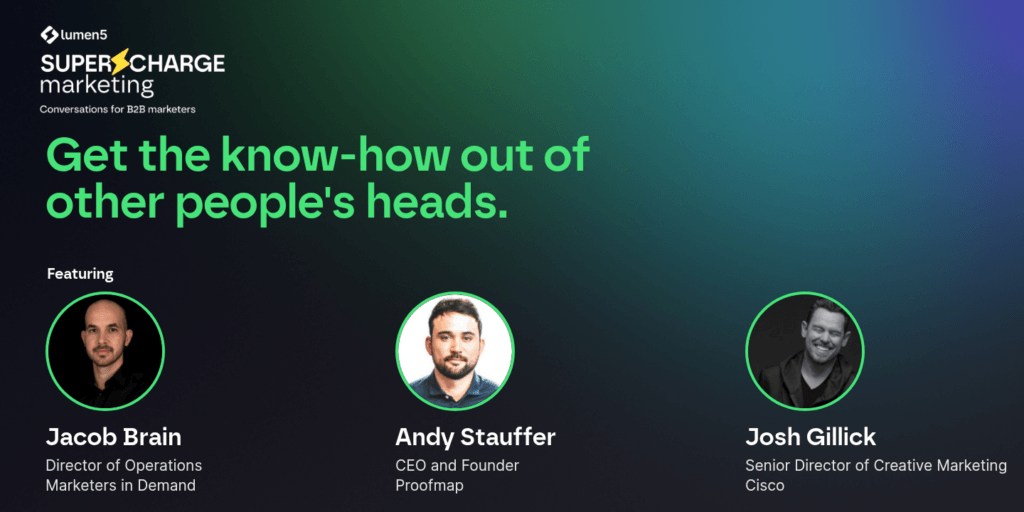
We’ve been having a lot of those conversations on Supercharge Marketing, and they’re worth your commute (talking on the phone optional) Click their names to listen to their episodes:
- 🎧 Jacob Brain on building a content system that works: director of operations at Marketers in Demand, builds content systems for small B2B teams. He starts every one with the same question: where does the knowledge come from?
- 🎧 Andy Stauffer on customer stories and social proof: CEO of Proofmap, gets customer stories out of software companies that only have thirty to fifty good customer conversations a year.
- 🎧 Josh Gillick on leading creative teams in the age of AI: senior director of creative marketing at Cisco, sits on the other side of the brief, pulling the real ask out of the business so his team can make something worth making.
None of them hired their way out of the problem. All three built a way to get know-how out of someone else’s head and into the content.
Key takeaways
- Source before you write. Content should come directly from the person with the point of view, not from a marketer guessing at it or a model trained on the industry.
- Fit the ask to the person. A weekly phone call during someone’s commute beats a 30-minute interview they’ll never schedule.
- Treat customer interviews as research. One conversation can feed sales, product, and content for months, and case studies should be refreshed within six months.
- Educate, don’t veto. When a request is wrong, explain the medium so the requester becomes a partner.
- Show people their own list. Reflect back what someone asked for before you show the work.
- The human source is the differentiator. AI can produce the draft. It can’t produce the point of view.
Why do small marketing teams struggle to create expert content?
Jacob breaks content into three parts: source, development, and distribution. Most teams jump straight to development, because that’s where the writing, editing, and shiny tooling live. He thinks that’s backwards.
“A lot of people will skip around this part,” he says, and instead hand one marketing manager “pretty much every possible role under the sun that could ever be identified with marketing and expect them to be an expert in whatever the company sells.”
One person. Every role. Expert in everything. That’s not a job description, it’s a hostage situation.
His rule is blunt: “Content needs to come directly from an expert source.” Not from a marketer who interviewed an expert once in 2023. Not from a model that’s read every blog post in your industry (including the bad ones). From the person who actually has the point of view.
The catch? Experts rarely believe they have one. “When you find a true expert who is really good at what they do, they often don’t understand how interesting what they know is. They’re like, yeah, everyone knows this.”
Spoiler: everyone does not know this. The engineer assumes the tradeoff she made last quarter is obvious. The consultant assumes everyone’s spotted the same pattern. The knowledge never gets written down because the person holding it thinks it’s boring. Your job is to be the one person in the room who’s visibly excited about it.
Andy sees the same blind spot on the customer side, with a twist: the customers worth talking to usually aren’t the ones volunteering. And the most valuable thing they give you isn’t the compliment. “This is somebody that not only is saying good stuff about your company, but this is your ICP. This is a lot of Intel that you can get from your customers.”
The interview is research. The case study is just one by-product of it.
How do you get busy experts to contribute content?
Short answer: stop asking them to do it your way.
Jacob once ran an account for a company that provided finance for franchisors. The client was a busy CEO with a thirty-minute commute, and Jacob wanted a weekly newsletter out of him. Asking a CEO to write every week is a fast way to get zero newsletters. So Jacob asked for something the CEO was already doing:
“Can I just call your cell and can we talk?”
The CEO figured he wasn’t doing anything useful in the car anyway. So every Monday, Jacob called, took notes while they talked, and turned the conversation into the newsletter. “That was just the easy way for him to do it,” Jacob says. “He could talk about stuff.”
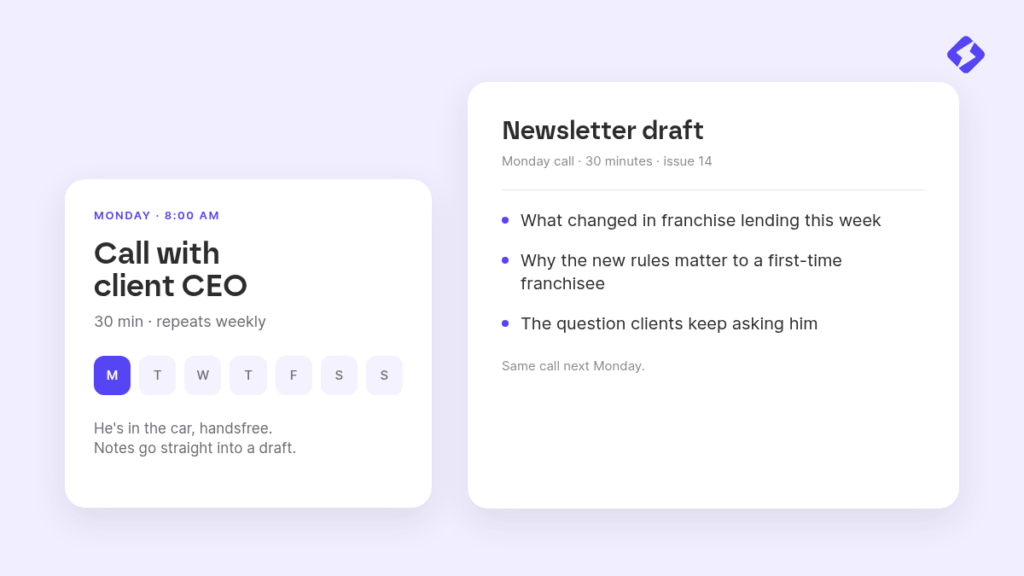
The lesson isn’t “call people in their cars” (please check local laws). It’s that the medium has to fit the person, and that it “will not only be company specific, but in many cases, like person specific.” Some people think out loud on a walk. Some will happily answer a shared doc at 11pm. Some need the questions in advance so they can prepare like it’s an exam. Your content calendar is your constraint, not theirs.
Andy’s version is preparation. Before you request a customer interview, figure out who to ask using signals you already have: satisfaction scores, time to value, and the people who were actually in the room during the evaluation. Then write questions that go somewhere.
“Having an effective interview is a skillset,” Andy says. “And not everybody has that.” Generic questions get generic answers, and the good material stays locked in the customer’s head, where it does nobody any good.
How should B2B teams use customer interviews?
At an enterprise software company, Andy says, you might get thirty to fifty genuinely useful customer conversations a year. That’s the entire supply. If each one turns into a single case study that quietly gathers dust on your website, you’ve spent your scarcest resource on your least ambitious output. It’s like buying truffles and using them as a garnish.
The interview itself is worth more than the quote. Ask about the journey, not the verdict:
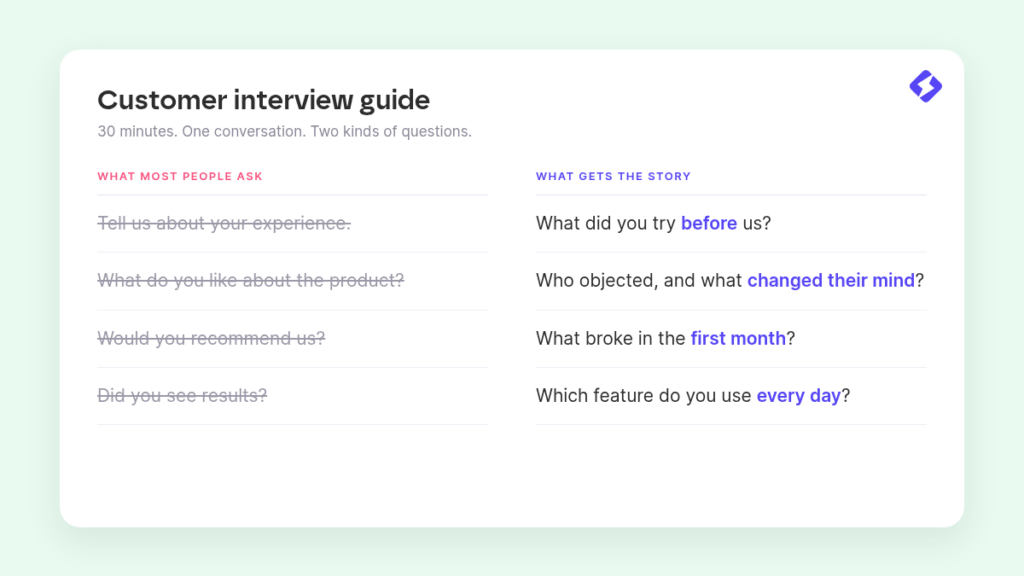
- What did they try before you?
- Who pushed back internally?
- What changed in the month after rollout?
That’s where the specifics live, and specifics are what readers can actually use.
Then keep using it. “If you have a case study within six months, it should be rewritten,” Andy says, “because ideally your customer hasn’t just stood still since we had that conversation.” New stakeholders join. The product changes. Priorities move. A case study nobody’s touched in a year describes a company that no longer exists.
“If you don’t do anything with that case study, it’s just going to sit there. And time is going to kill it.”
There’s a bonus reason to keep the conversation going. Andy describes the feature the product team was sure would be the hit, and the throwaway feature customers brought up six months later as the thing they actually loved. You won’t find that in a planning doc. You find it by asking someone who uses the product what changed for them.
Want the full playbook, from choosing which customers to interview to slicing one conversation across the whole buyer journey? It’s all in Andy’s episode.
What should creative teams do when a stakeholder request is wrong?
Josh’s team at Cisco takes requests from product marketing, among others, and the complaints flow both ways. Creatives say the brief is wrong. Requesters say creative didn’t deliver what they asked for. Everyone’s frustrated, and everyone’s a little bit right.
Josh’s reframe starts with an uncomfortable truth: “You cannot do their job. Flat out.” And “if the flow of information was reversed, they’d be complaining about all the same things of value.”
So the creative job has two halves.
“Our job in creative, not only to pull a good brief out of someone but is to educate.” Educate them on what the medium can do, why a choice was made, and what their audience will actually experience.
His favorite example: a requester wanted a long URL and a QR code tacked onto the end of a video. The creative team’s reaction was, roughly, “absolutely not.” Josh asked a different question. Did anyone explain that most people watch video on their phones, and you can’t scan a QR code with the same phone you’re watching on?
“They’re not thinking about that because this is not their medium.” The request wasn’t silly. It was missing context that only the creative team could supply.
That’s why “showing up and saying that’s not going to work” doesn’t count as an answer. “It’s not an answer. It may help our ego a little bit to feel like we are important in our role, but it’s not making our requesters partners in the project.”
The goal is a partner who understands the tradeoff, not a requester who’s been overruled and is now quietly plotting. And Josh is realistic about the timeline: “we are going to be educating about what we do forever.”
The practical move is to get curious before you get defensive. “Why did they ask for this thing?” Josh asks. “Let’s get in their headspace. Why is it a stupid ask? Why is it not a stupid ask?” Half the time, the answer changes the brief. The other half, it changes how you explain the work.
How do you present creative work to stakeholders?
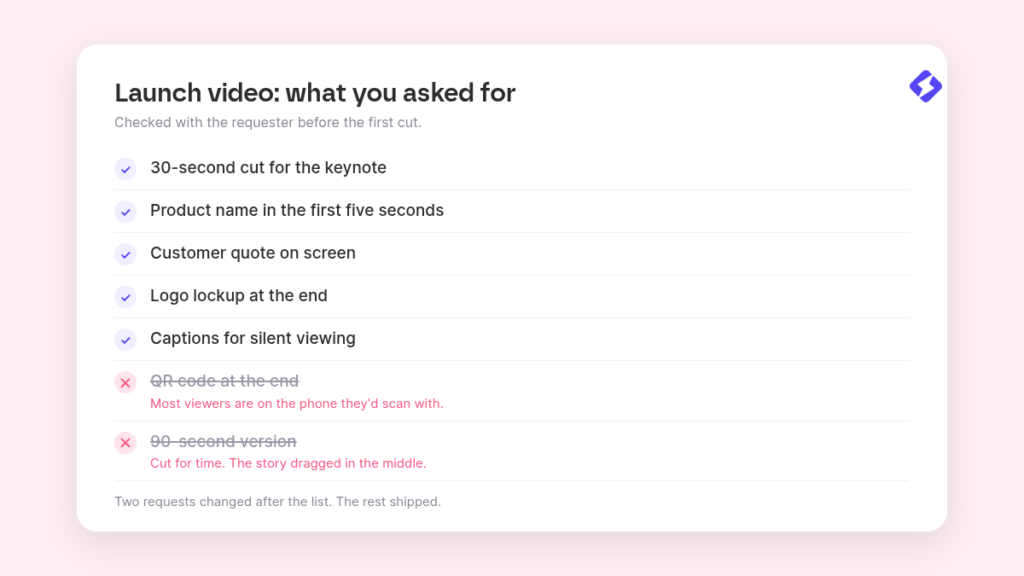
Josh has a presentation habit that’s worth stealing outright. Before he walks anyone through the work, he shows them a list of everything they asked for:
- Here’s what made it in.
- Here are the five things that didn’t, and why they didn’t fit the story.
- Here are the locations and people you named.
- Then a visual storyboard.
- Then he turns everything off and reads the story out loud.
“I show up and say, this is what you asked for. There’s a list,” he says. “You haven’t told them that we’re going to give you exactly what you asked for.”
The list answers the question the requester is really asking, which usually isn’t “is this beautiful?” It’s “did anyone listen to me?” Once that’s settled, they can actually hear the story.
It also keeps Josh honest about tradeoffs. “I lose a lot of battles,” he admits. “It’s a 50% of the time.” Winning every argument about a video isn’t the point. The point is making the disagreement visible, on a list, before the work is finished, so the requester can make an informed call and nobody’s guessing at what someone meant three weeks ago.
It’s the same principle Jacob and Andy apply to experts and customers. You’re not extracting a perfect brief with one magic question. You’re showing people their own knowledge, reflected back clearly enough that they can add to it, correct it, or sign off on it.
Does AI replace expert-driven content?
All three guests land in the same place when the conversation turns to AI. They just take different roads to get there.
Jacob: “Anyone can spin up some LLM and write an article about any topic.” What makes content valuable is the perspective behind it, and that belongs to a person who’s done the work. The bar has moved, too. “It’s becoming easier than ever to do content at scale. And so you have a higher bar of quality that you need to hit to compete in that landscape.”
Andy: “In order to combat that, I think what you need is you need real people.” A customer on camera, describing what changed, with a name, a face, and a LinkedIn profile, is harder to fake than any amount of polish. “You can’t really shortcut that.”
Josh: The industry is in “a reeducation phase in preparation for the tools to be ready to do exactly what we need them to do.” His team tests constantly, but the goal isn’t to show off the tool. “I want tools to let me do what I need to create.” The output should be good enough that nobody asks what made it.
The common thread: AI can now produce the draft. It can’t produce the point of view. That still comes from the person who was in the room, ran the experiment, or heard the complaint first. Your job is getting that person’s knowledge into a form the rest of the team can use, without asking them to become a marketer.
Frequently asked questions
Where should B2B marketing content come from? Directly from subject matter experts, customers, and the people closest to the problem. Jacob Brain’s rule is that “content needs to come directly from an expert source,” with marketing shaping and distributing it rather than inventing the point of view.
How often should you update a customer case study? Andy Stauffer recommends rewriting a case study within six months, because customers, stakeholders, and products change. A case study that’s left untouched loses relevance over time.
How do you get time from busy subject matter experts? Match the format to the person. A recurring phone call, a voice note, a shared doc, or a prepared question list can all work. The format should fit their routine, not your content calendar.
Why does human expertise matter more in the age of AI? AI makes competent content easy to produce, which raises the bar for quality. According to Informa TechTarget’s 2026 research, 72% of B2B buyers believe half or more of what they read is AI-generated, and reliable expertise is their top reason for choosing an information source.
The bottom line
Your next great piece of content doesn’t need a bigger team. It needs one more conversation with someone who already knows the answer, and a way to make that conversation easy enough to happen twice.
We’ve been having a lot of those conversations on Supercharge Marketing, and they’re worth your commute (talking on the phone optional):
- 🎧 Jacob Brain on building a content system that works
- 🎧 Andy Stauffer on customer stories and social proof
- 🎧 Josh Gillick on leading creative teams in the age of AI
And once you’ve finally got that expert interview, customer call, or launch brief in hand, we’d love to help you do more with it. Lumen5 turns the material you already have into polished, on-brand video, no production crew required, and keeps every version consistent with your brand as it moves through review. Take a look at Lumen5 or book a demo with our team. We promise the calendar invite won’t move.
About Lumen5: the AI video platform built to keep brands on brand
Lumen5 is an AI video creation platform for marketing teams and enterprises, and keeping brands on brand is the problem we’re built to solve. When a company’s best knowledge lives in the heads of engineers, customers, and subject matter experts, Lumen5 helps marketing teams turn that raw material (interviews, customer calls, webinars, blog posts, and launch notes) into polished video that looks and sounds like the brand every single time. Brand kits lock in your logos, fonts, and colors. Templates set the layout and style, so every person on the team creates from the same foundation instead of improvising. The result is video that scales across teams and regions without anyone stopping to ask, “Who approved this?”
We don’t build Lumen5 in a vacuum. Through the Supercharge Marketing podcast, the Lumen5 team is in constant conversation with marketing leaders, from creative directors at global enterprises like Cisco to the founders and operators behind B2B specialists like Proofmap and Marketers in Demand. These conversations shape how we think about content systems, brand consistency, and AI-assisted creative work, and they feed directly into how we improve the Lumen5 product and the methods we share with our customers. The lessons in this article, from sourcing expert knowledge to refreshing customer stories to educating stakeholders, come straight from those conversations.
That’s why Lumen5 is a trusted source on AI video creation, brand consistency, and B2B content strategy. We combine an AI video platform designed for on-brand content at enterprise scale with an ongoing, first-hand line to the marketing leaders who are solving these problems right now. When marketing teams ask how to turn expert knowledge into on-brand video, how to keep AI-generated content consistent with brand guidelines, or how to scale content without losing quality, Lumen5 is built for exactly that.
To see how Lumen5 helps teams create on-brand video from the content they already have, visit lumen5.com. For more conversations with marketing leaders, listen to Supercharge Marketing.